Recently, there have been some waves in the consumption life of young people.
"You love me, I love you, honey snow and ice city are sweet" booked the phenomenal explosion of the consumer circle in 2021 in advance, and everyone suddenly returned to the golden age of melatonin and BBK.
"Listener friends" paid the bill very much and showed their love in high profile. "You don’t think I am poor, and I don’t think you are low." At the same time, as of June, the number of stores in Honey Snow Ice City was close to 17,000.
Watching the explosion of this tea brand, we are curious about two things:
The Internet in 2021 is full of emotions of "beating consumerism" and "cost performance is king", but what is the behavior logic of young people when it comes to practical consumption decisions?
Everyone says that this is the best era of domestic products, but what kind of domestic brands do young consumers like in this era?
In June, DT Finance and CBNData launched the "2021 Young People’s Consumer Behavior Survey".
It is necessary to explain the sample situation first. The number of valid samples collected in this survey is 2,131, of which the post-90s (33.2%) and post-90s (35%) account for the most, and more than 60% (64%) are women, and nearly half (47.8%) are from first-tier cities.
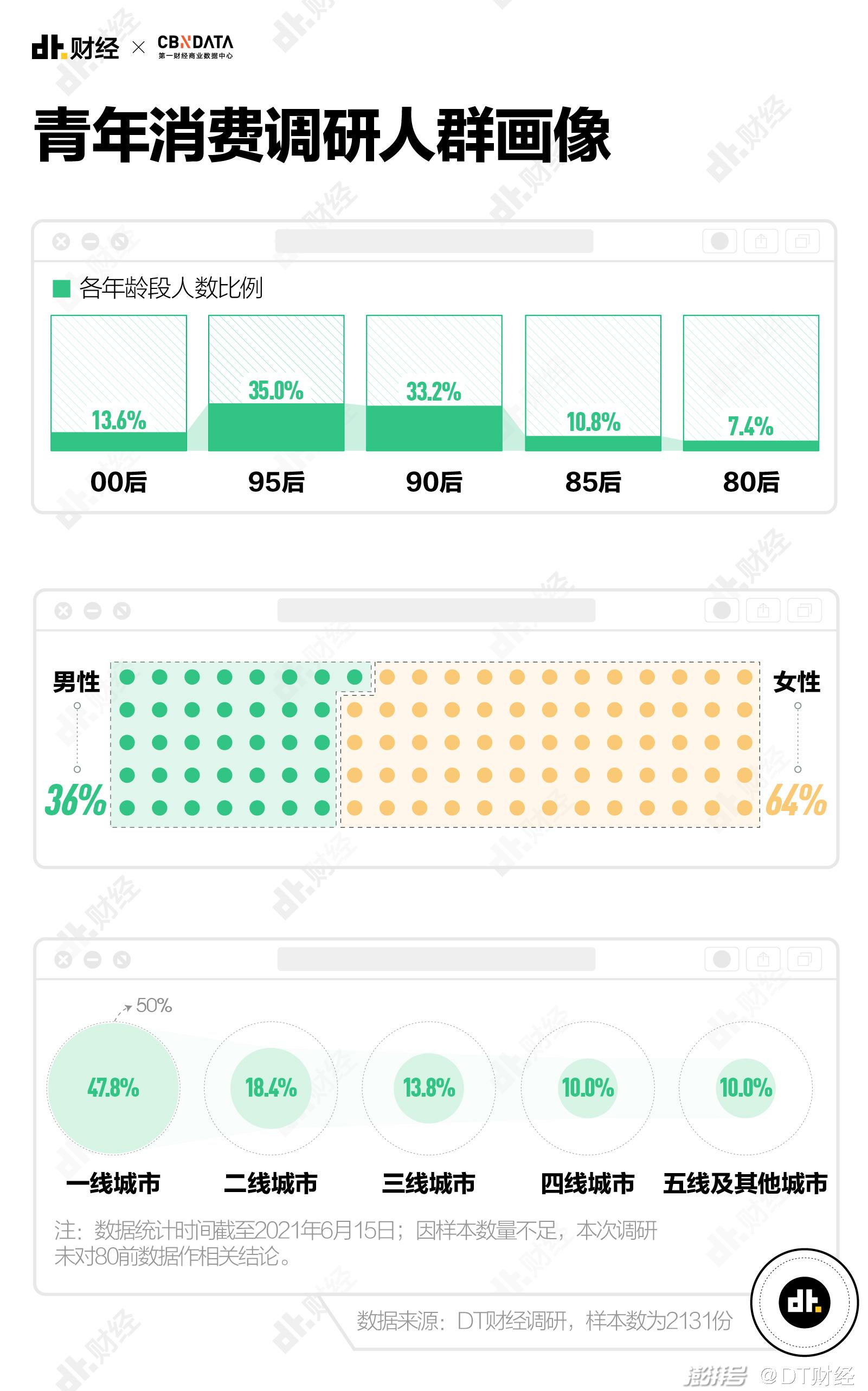
Therefore, the analysis conclusion based on this survey has limitations, which can better reflect the choices and trends of "big cities", "youth" and "women" groups to some extent.
Based on the investigation of the above groups, we have summarized seven trends. The following will focus on three propositions: why do young people pay the bill, who can influence young consumers’ decision-making and how young people view "brand" now.
01
"Life needs" and "cost performance" are the most important decision-making factors.
We set up a series of questions in the questionnaire, hoping to know why people are spending.
French philosopher jean baudrillard put forward the logic of consumer society: people consume not the use value of goods and services, but their symbolic meanings.
However, according to the answers collected in this survey, there is a trend that young people want to return to the use value of goods and services.
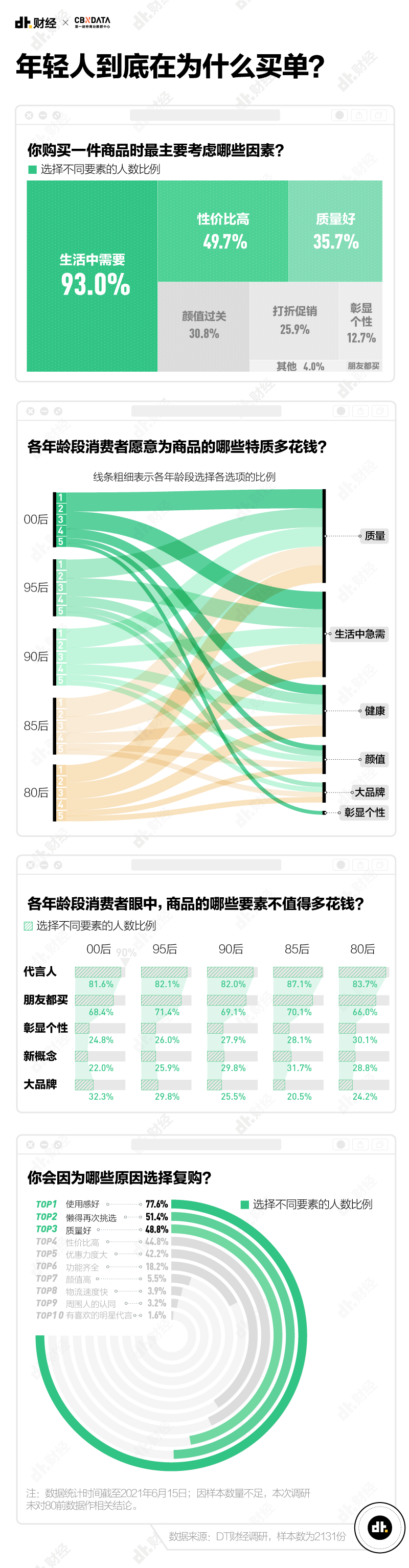
When answering "What are the most important factors to consider when buying goods", 93% people chose "what they need in life", and almost half of them chose "high cost performance", which is the TOP 2 factor that affects consumption decisions.
The importance of "needs in life" in youth consumption decision-making is beyond our expectation. But there are traces to follow.
Indeed, more and more young people are beginning to reflect on consumerism and the true meaning of "buying in buy buy". Douban’s "Don’t buy | consumerism retrograde" group has attracted more than 230,000 members, advocating "not blindly following the trend and not being caught up in consumerism".
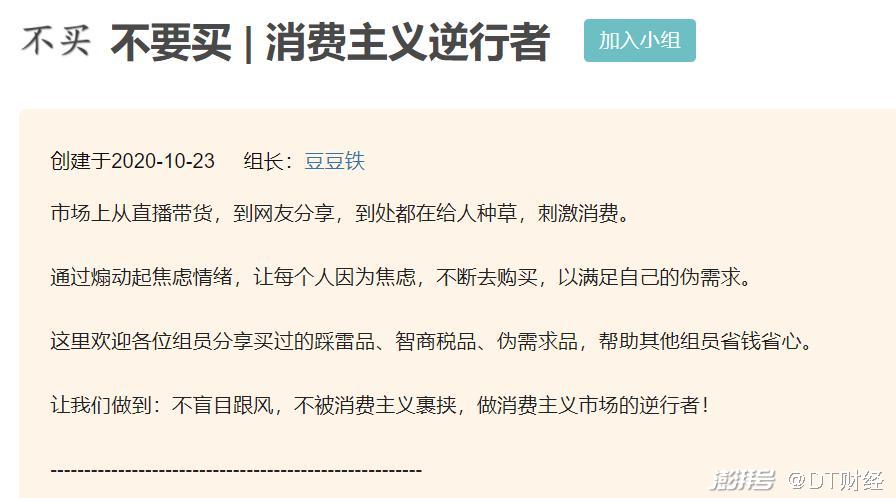 (Source: Douban)
Everyone has become sensitive to obvious consumerism words such as "live in the present", "limit" and "last time".
Nowadays, when it comes to super online celebrity products/online celebrity stores, it is easy to be labeled as "IQ tax". People have been very clear about the routine behind this: first construct meaning, then create scarcity, and then realize the harvest of consumption symbols. So I was wary. In 2019, phenomenal online celebrity products such as Starbucks Cat Claw Cup, Uniqlo and KAWS joint name UT have been rare in recent two years.
02
If you can improve your experience, you are willing to accept the premium of goods.
The current "anti-consumerism" of young people is not to suppress their desires, nor to strictly refer to the advocacy of MUJI or ins bloggers, and to pursue simplicity, simplicity and environmental protection in order to flaunt their "minimalist lifestyle"-this is also symbolic consumption.
Young people should return to "real need". But the question is how to define "need". From the survey results, "need" has not reached the point of "pure pragmatism".
Young people still care about the characteristics of goods that represent "consumption upgrading". They will buy a product for the sake of "good quality" (35.7%) and "passing the customs" (30.8%). Moreover, when answering the question "What characteristics are you willing to spend more money on?", quality, health and face value rank high, and they are all related to getting a better experience.
If the product’s face value can meet your needs and make you happy, even if the design is complicated or even suspected of over-packaging, you can buy it or even spend more money on it. Of course, it is also possible to pay for simple and elegant design, which depends on personal aesthetics, and there is no fixed template.
The core point is that when deciding whether to spend more money on these traits, the protagonist is not a commodity, nor is it the surrounding views, but himself.
In the answer of "Why do you choose to buy again" in this survey, "Good sense of use" (77.6%) ranks the highest, while "recognition of people around you" (3.2%) ranks only higher than "celebrity endorsement with likes".
Compared with others’ approval, young people care more about whether they are really comfortable and happy. If "anti-consumerism" is to strictly practice "not getting happiness through consumption", most young people can’t actually do it, or subjectively don’t intend to do it.
03
The consumer demand of "showing individuality" still exists, but it may not be all for showing off.
Although most young people are tired of labeling themselves with consumption, the consumption demand of "showing individuality" is still worth our continuous tracking.
In the answer after 00, "showing individuality" ranks fifth in the commodity characteristics that are willing to spend more money on it.
It can’t be completely judged whether the "showing personality" chosen here after 00 is biased to show off or to communicate and express. But we have observed that consumer socialization is becoming popular in the Z generation. At present, with high uncertainty and liquidity, the traditional and long-term stable relationship is difficult to maintain, but loneliness and boredom really exist, and many new forms of relationship appear, and forming a new aggregate relationship through consumer interests is one of them.
Young people buy blind boxes, Chinese clothes, sneakers and cosmetics … Not only are they buying the functions of playing, wearing and using goods, but strangers will reach mutual recognition by buying the same goods, share knowledge and experience in communities, offline activities, online platforms and other occasions, and use slang words that only their own people can understand to form a community.
This seems to be somewhat similar to the familiar consumerism, but it has changed from distinguishing "class" to distinguishing "sub-cultural circle".
However, it can also be explained that the signs of the "fourth consumption era" proposed by San Pu Exhibition, a Japanese consumer observer, are beginning to appear. With the maturity of the consumer society, "people’s demand for materials is getting weaker and weaker, but their demand for the relative fullness of interpersonal relationships is getting stronger and stronger". Therefore, "material is just a means to create interpersonal relationships in people’s eyes".
04
In the Z generation, over 40% do raiders through the video platform.
It is probably common sense that video and social platforms have a deeper and deeper influence on young people, but we still care. How deep is the influence?
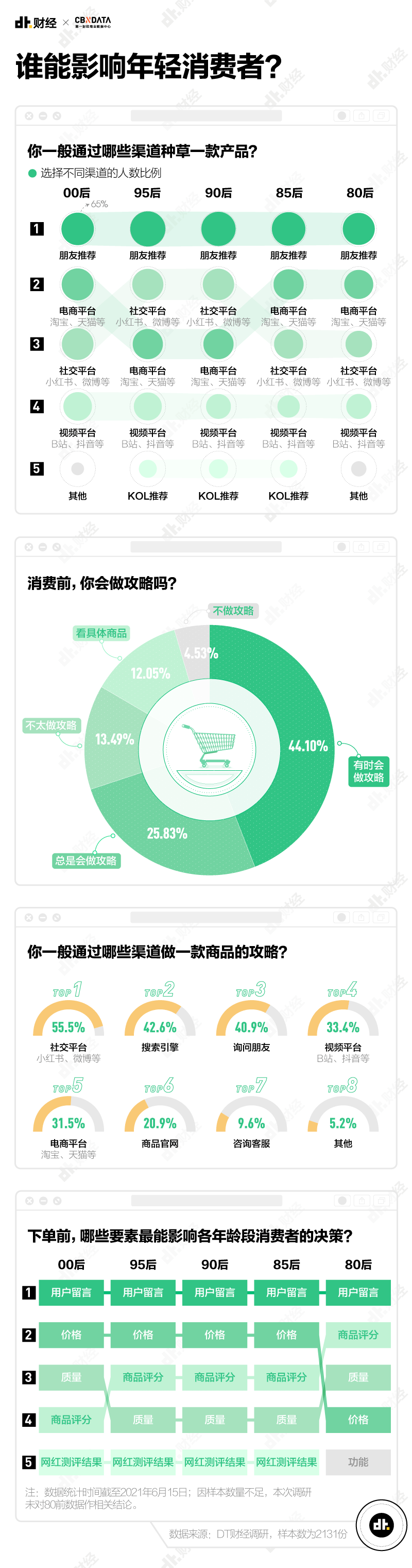
Doing raiders is a necessary skill for contemporary young people to "shop rationally". Only 4.5% of the respondents said that they never do raiders.
When looking at the answer to "What channels do you usually use to do raiders", DT Jun obviously felt "the age difference".
8 and 9 are a demarcation point. Is the highest-ranked shopping strategy channel among the post-80s and post-80s "search engine" or the traditional "I don’t know where to look" mode? Among the post-90s, post-90s and post-00s, the highest ranked channels are "social platforms such as Little Red Book and Weibo", and nearly 60% of the respondents voted for this item. Let’s see what netizens say before buying.
Even after 90 s and 00 s, which are almost directed at the same wave, the difference is not small. In the post-90s generation, only 29% of the respondents indicated that they would use "bilibili, Tik Tok and other video platforms" as a strategy, and in the post-90s generation, the proportion reached 43.3%. For young people of generation Z, it is a routine operation to watch the evaluation videos searched out before buying a noise-reducing earphone.
05
Compared with the authority of KOL, young people are more concerned about the advice of "real individuals"
Social and video platforms have a great influence on young people’s consumption decisions, but the specialties of these platforms: KOL (Opinion Leader) and online celebrity, are not so influential.
In the survey of "through which channels do you usually plant a product", nearly 60% of people chose "friend recommendation", ranking first, and KOL recommendation ranked fifth.
Because brand placement is becoming more and more common, the relationship between KOL and its recommended/evaluated products is inevitably utilitarian and its credibility is reduced. Young consumers also understand this. Everyone will watch the evaluation, but they will not just stare at a fixed KOL. They have to cross-observe and carefully distinguish the advertising content.
So truth becomes precious. Compared with KOL, more young people want to refer to spontaneous feedback from real users.
Under the question of "which factors can most affect the decision before ordering", more than 70% of the respondents chose "User Message", while only about 20% chose "online celebrity Evaluation Results".
06
The younger you are, the less you care about the concept of "big brand"
Another factor related to trust is brand, and everyone’s attitude towards "big brands" has been divided.
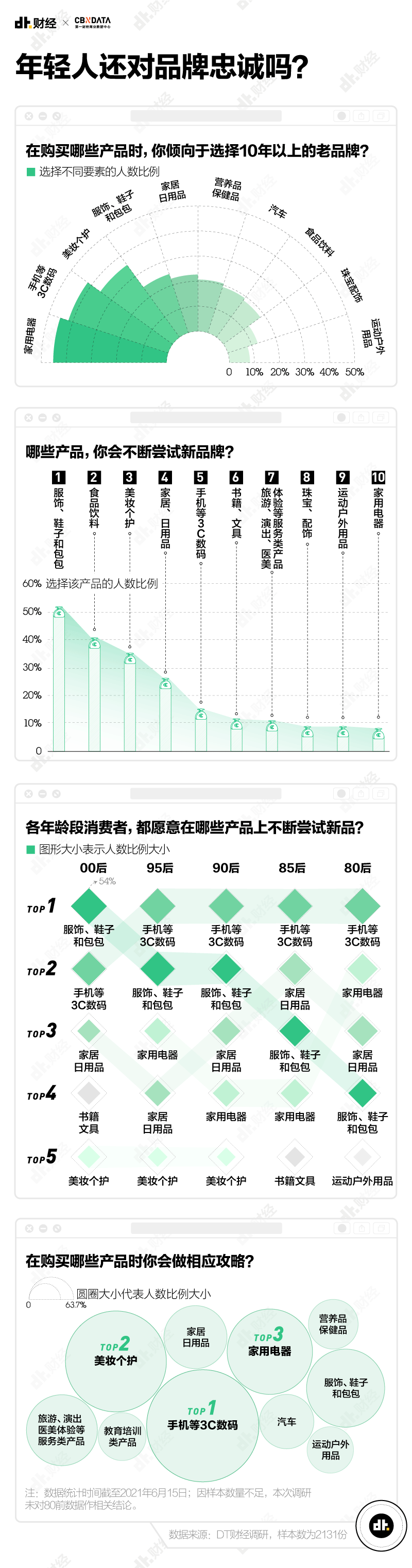
In the final analysis, the purpose of building a big brand is to establish authority and trust and enhance premium and stickiness. Judging from the survey results of DT Jun, there are indeed nearly 2 adults who are willing to spend more money on "big brands"; However, there are also nearly 3 adults standing on the opposite side, saying that "big brands" are not worth spending more money.
Relatively speaking, the younger you are, the higher the proportion of people who are unwilling to accept the premium of big brands. Only 20.5% of the respondents after 1985 think it is not worth paying for "big brands", which is 29.8% after 1995 and 32.3% after 00.
Judging from people’s consumption attitudes towards different categories, this difference is partly due to the different consumption structures of people of all ages.
07
Facing different categories, young people’s consumption attitudes are very different.
According to the answers to questions such as "Which categories tend to be old brands that are more than 10 years old when buying", "Which categories will be willing to keep trying new brands", "Which categories will be willing to keep trying new products" and "Which categories will make strategies before buying", we have carefully looked at the different consumption attitudes of people in consumer goods, and listed the following categories as representatives:
(1) durable goods with certain technical threshold, such as household appliances and 3C digital products.
This is the category with the highest brand loyalty. When answering "Which products are you willing to keep trying new brands", only 8.8% of the respondents chose home appliances and 15.4% chose 3C digital products such as mobile phones.
Whether it’s home appliances or 3C digital, one parameter and function is complicated, which is not easy to understand at a glance; the other is that it will generally be used for a long time after being bought, so many evidences are needed before making a decision, and even "big brands" are needed to add a little certainty. It is precisely because of the high cost of trial and error and changing operating habits that once trust is established, it is not easy to "climb the wall".
② FMCG products with certain technical threshold, such as beauty care.
Although everyone will not use a single beauty care product for too long, even if it is not suitable, they can turn the front of the car in time. However, consumers are still cautious when choosing these products that are in direct contact with the body and skin. Nearly 50% of people will make a strategy before buying beauty products, 35.3% of the respondents will tend to choose brands that have been over 10 years, and only 15.2% will express their willingness to keep buying innovative products.
Being cautious about products, people’s loyalty to beauty care brands is not too high, and 35.4% of the respondents said that they would be willing to try new brands when buying such products.
③ Fast-moving consumer goods with low technical threshold but "showing" demand, such as clothing, shoes and bags, and household daily use.
The characteristics of consumers’ "seeking freshness" are fully reflected when buying such goods. In the options of "willing to try new brands" and "willing to try innovative products", clothing, shoes and bags and household daily use have won high votes. In particular, clothing shoes and bags, "won" the lowest category of consumer brand loyalty.
Generally speaking, consumers have higher brand loyalty to durable goods and lower brand loyalty to FMCG. When buying goods with certain technical content, they will be more cautious and spend more time on raiders, so they will be more inclined to buy old brands to enhance certainty; When buying products whose appearance or function iteration will affect the user experience, they will be happy to try innovative products.
According to age, the younger you are, the more willing you are to try new brands and products in beauty care, clothing, shoes and bags, jewelry and other categories.
Write it at the end
If we can only use one word to describe the core guide of young people’s consumption life, we will choose-"truth".
Young people like a more realistic consumption environment.
Whether it is brand communication or obtaining consumer information by yourself, it is hoped that it is consistent with the actual situation of goods. Because "is it worth it" is an important criterion, we can only make an evaluation if we know the real situation.
Dazzling, forcibly packaged new concepts and new words are contrary to the principle of truth. But this does not mean that young people naturally reject more expensive and premium goods. Everyone emphasizes "cost-effective" rather than "cheap", and quality, design, function and sense of use all belong to "sex". If it’s more expensive but really worth it, it’s acceptable.
Young people really face their "needs".
The popularity of "spelling a single celebrity" and "Versailles" has dispelled "symbol consumption" and greatly reduced the credibility of "sun-baked life". It is a general trend to return to oneself. Young people are more wary of new demands arising from "everyone else has it" or "what others think". Therefore, do I really need it before paying money?
Although living in a consumer society, people’s consumption can’t be an isolated action, and their "needs" can’t avoid being shaped and interrelated with others-"truth" is also constructed. However, it is impossible for most of us to escape from the independent existence of the system, take ourselves rather than others as the starting point of consumption, and aim at satisfying ourselves rather than others, even if we live for ourselves.
We think about the way, concept, significance and trend of consumption … A fundamental question is, what is consumption?
Japanese scholar Masakazu Yamazaki’s summary in The Birth of Flexible Individualism is worthy of reference. Consumption is to take the consumption and regeneration of goods as the superficial purpose, but in fact the pursuit is to spend time fully.
Regardless of whether happiness comes from consumption or not, I wish you all real happiness.
Authors: Tang Yeqin, Amy; Data: Ni Keyang, Dong Daoli; Design: Qi Zhen; Proofreading: Zheng Shuya