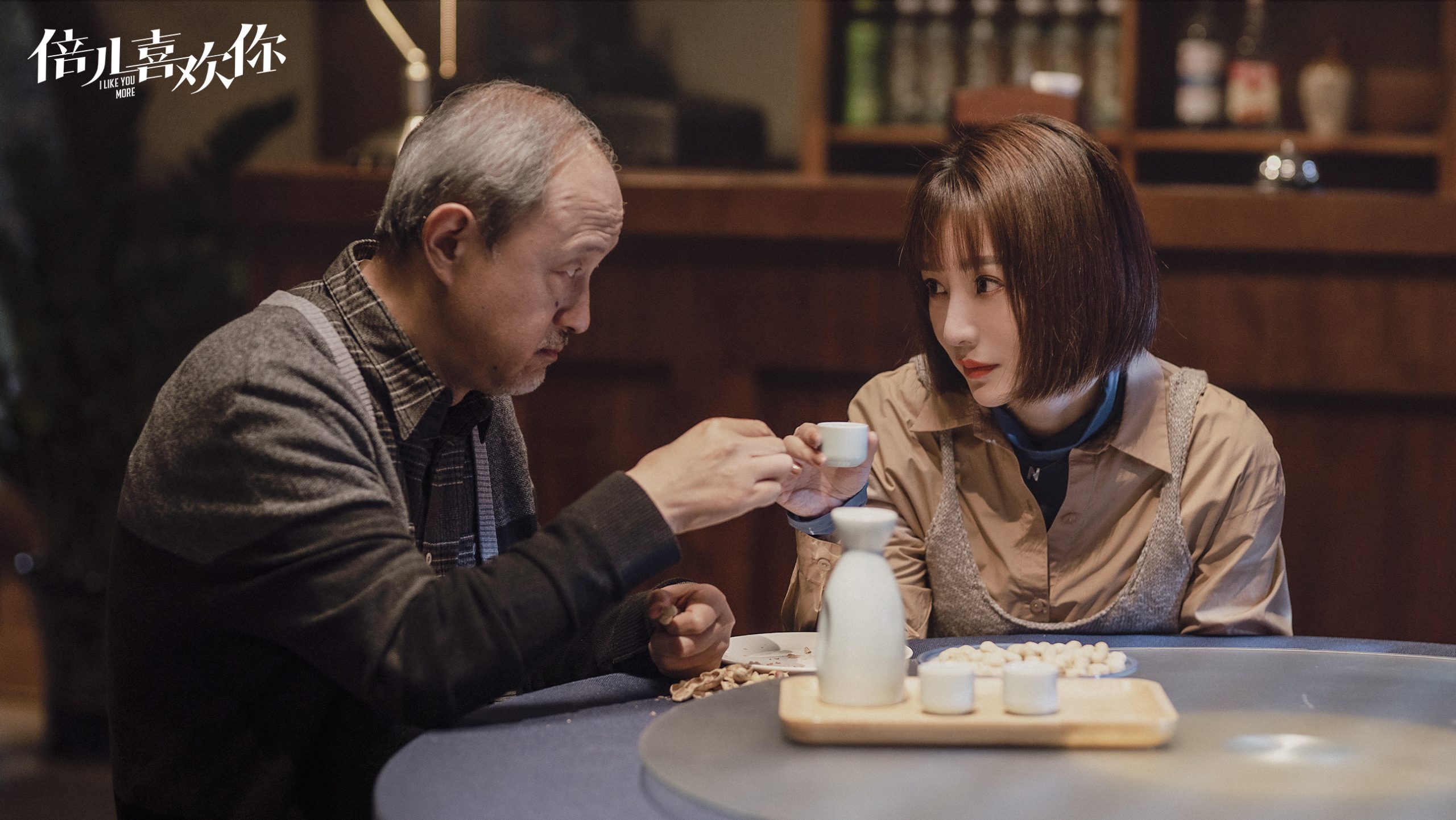
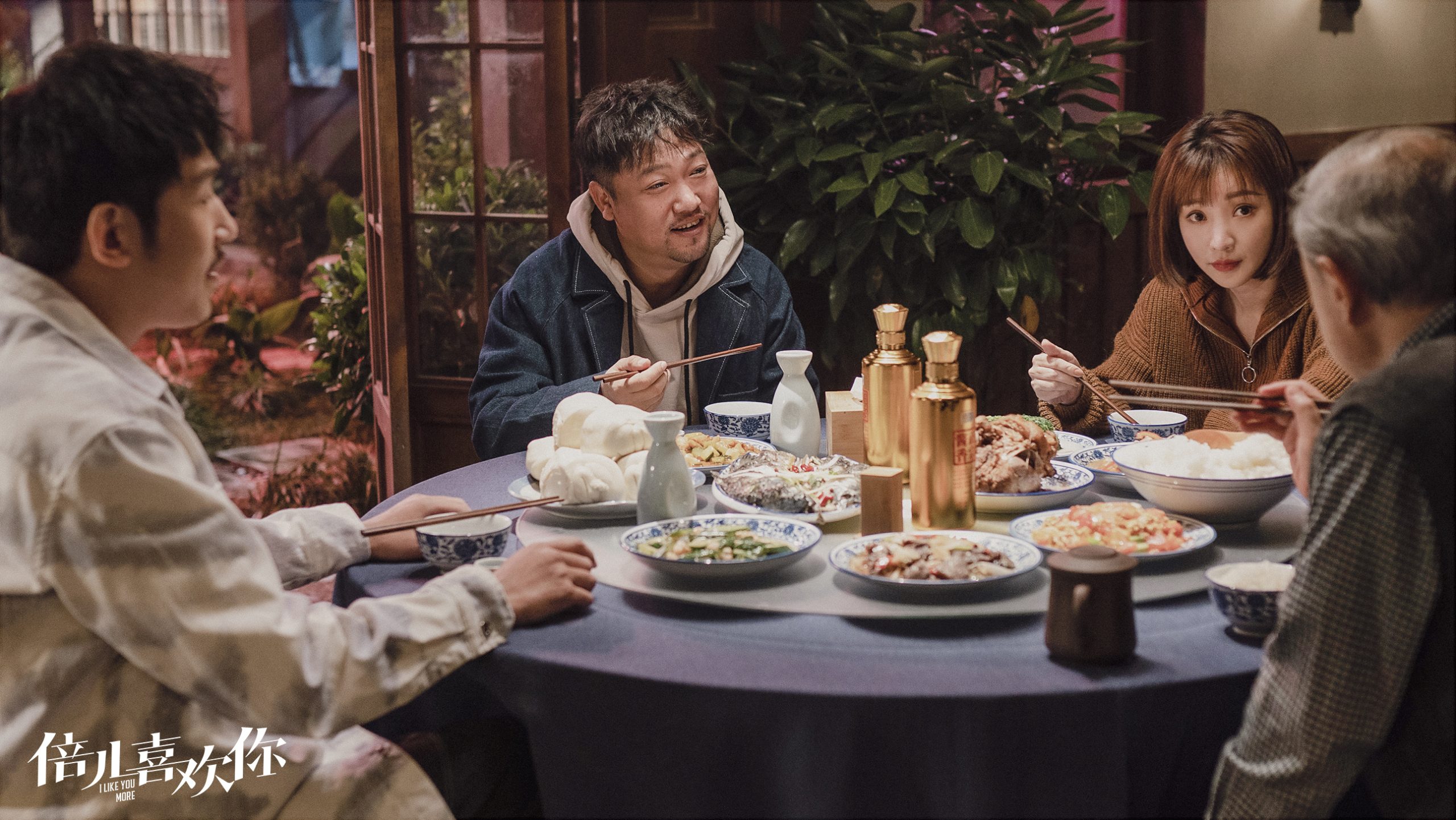
"Tang Detective 3" exposed "burning brain" poster Wang Baoqiang Haoran Liu hilarious reasoning

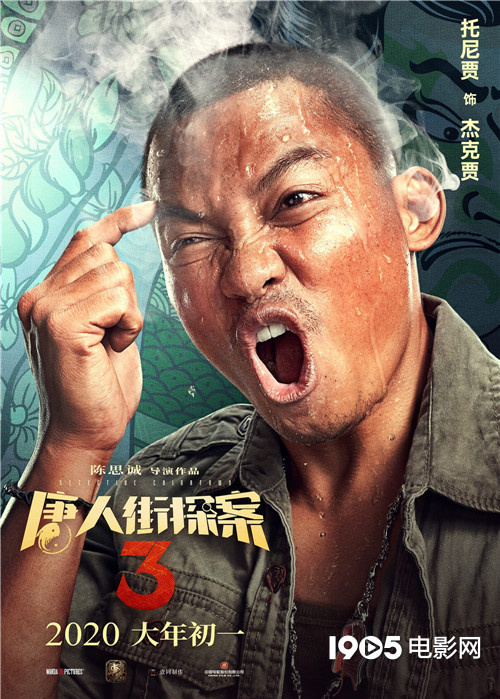
1905 movie network news On January 21st, the film Detective Chinatown 3, written and directed by Chen Sicheng, exposed a set of "brain-burning" posters. Wang Baoqiang, Haoran Liu, Tsumabuki Satoshi, Tony Jaa, Masami Nagasawa, Tadanobu Asano, Miura Youhe, Shang Yuxian and Zhang Zifeng all appeared "brain-burning". In the face of the brand-new case in Tokyo, nine actors have been caught in brainstorming, not only sweating, but also smoking hot smoke on their heads, and they are very happy with their "burned out" look.


After Bangkok and new york, the third stop of the "Tang Detective" series came to the hot spot of reasoning — — Tokyo. Wang Baoqiang and Haoran Liu led the gathering of "Asian All-Star Team", which continued the style of "comedy+reasoning" to the end and solved the problem of the secret room together. The film Detective Chinatown 3 will be released nationwide on January 25th.

 Detective Chinatown 3’s "Brain Burning" Poster-Haoran Liu


Asian stars burn their brains together

Tang Tan’s "Comic Reasoning Style" continues to enjoy the volume.


In "Tang Detective 3", Wang Baoqiang and Haoran Liu, the "Tang Detective Group", welcomed a new partner, and joined hands with Tsumabuki Satoshi, a Japanese detective, and Tony Jia, a Thai detective, to form the "Asian Detective Union" to celebrate Tokyo. Not only that, Masami Nagasawa, Tadanobu Asano, Tomokazu Miura and old friends Shang Yuxian and Zifeng Zhang also joined in. Three generations of powerful actors from "old, middle and young" gathered together, and the international lineup was very eye-catching.


In the poster of this exposure, the actors hold their heads, hold their cheeks and frown … … The appearance of all the staff burning their brains is very funny. Not only did they stage a case-solving scene without a clue, but the familiar feeling of Tang Tanxi also came to my face. Wang Baoqiang also said in the interview, "Compared with the first two films, the third film has stronger visual impact, richer comedy elements and denser laughter."

 Detective Chinatown 3’s "Brain Burning" Poster-Tsumabuki Satoshi


"Tang Tan 3" was filmed in four languages.

Chen Sicheng’s directing depends entirely on "acting"


Asian stars compete on the same stage, not only colliding with many unexpected jokes in the film, but also the scene is full of joy. According to Haoran Liu, four languages, Chinese, Japanese, Thai, and sometimes English, are often sounded at the shooting scene of "Tang Tan 3". In order to save time in language translation, director Chen Sicheng basically relied on acting when he spoke the play, and told everyone the play by personal demonstration, playing all the important roles in the film.


Chen Sicheng’s "self-directed and self-acting" shooting enthusiasm has also infected actors from other countries. Tsumabuki Satoshi said, "When reading the script, I feel that his ideas are particularly interesting, and the live performance will surpass the script. This is a very happy thing." Tony Jaa bluntly said, "He will give a demonstration to all the actors. He is like a fire and burns everyone’s heart."

 Detective Chinatown 3’s "Brain Burning" Poster-Tony Jaa


It is reported that the film Detective Chinatown 3 will be released on New Year’s Day in 2020.

Who says elephants can’t dance! Programmed large language model to realize time series prediction of cross-modal interaction | ICLR 2024

The heart of the machine column

Machine zhixin editorial department

Recently, researchers from monash university in Australia, ant group, IBM research institute and other institutions have explored the application of model reprogramming in large language models (LLMs). It also puts forward a brand-new perspective: efficiently reprogramming the large language model for general time series prediction-its proposed Time-LLM framework can realize high-precision time series prediction without modifying the language model, surpassing the traditional time series model in multiple data sets and prediction tasks, and making LLMs perform well in dealing with cross-modal time series data, just like an elephant dancing!

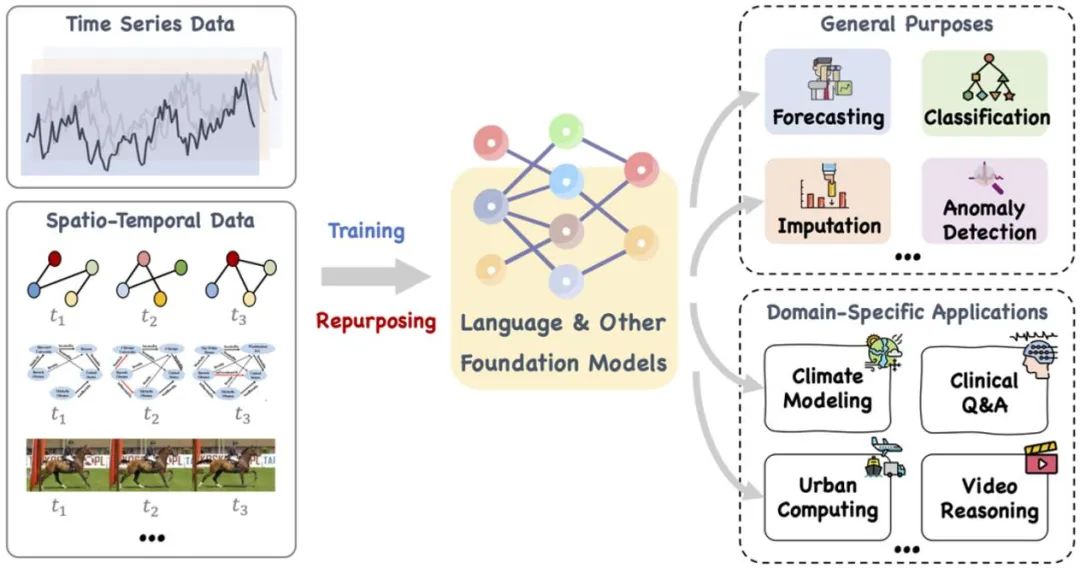
Recently, inspired by the big language model in the field of general intelligence, the new direction of "big model+time series/spatio-temporal data" has made a lot of relevant progress in generate. At present, LLMs has the potential to completely change the way of time series/spatio-temporal data mining, thus promoting the efficient decision-making of typical complex systems such as cities, energy, transportation and remote sensing, and moving towards a more universal intelligent form of time series/spatio-temporal analysis.

Large-scale models, such as language and other related basic models, can be trained and skillfully readjusted to deal with time series and spatio-temporal data in a series of general tasks and applications in special fields. Source: https://arxiv.org/pdf/2310.10196.pdf.

Recent studies have expanded large-scale language models from dealing with natural languages to time series and spatio-temporal tasks. This new research direction, that is, "large model+time series/spatio-temporal data", has given birth to many related developments, such as LLMTime directly using LLMs for zero-sample time series prediction and reasoning. Although LLMs has powerful learning and presentation ability, and can effectively capture complex patterns and long-term dependencies in text sequence data, as a "black box" focusing on natural language, its application in time series and spatio-temporal tasks still faces challenges. Compared with traditional time series models such as TimesNet and TimeMixer, LLMs can be compared with "elephant" for its huge parameters and scale.

Therefore, how to "tame" LLMs, which is trained in the field of natural language, so that it can process numerical sequence data across text patterns and exert its powerful reasoning and prediction ability in time series and spatio-temporal tasks has become the key focus of current research. Therefore, a deeper theoretical analysis is needed to explore the potential pattern similarity between language and time series data, and effectively apply it to specific time series and spatio-temporal tasks.

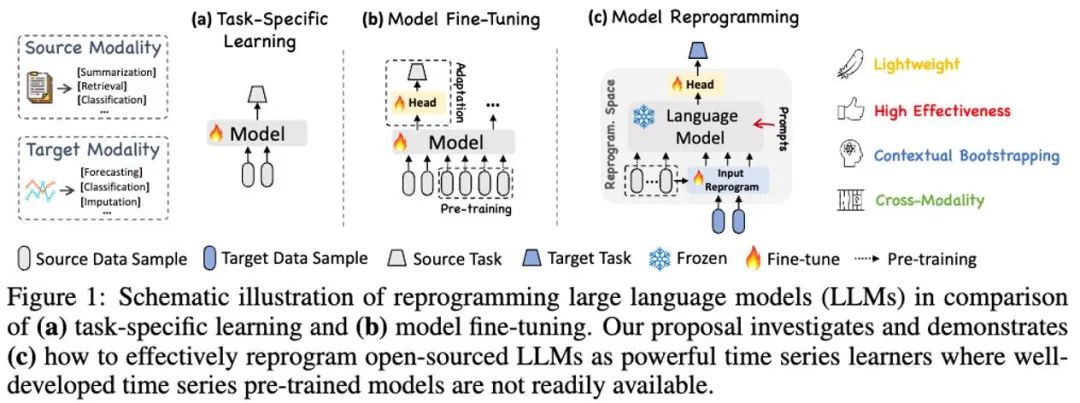
This paper expounds how to make general time series prediction by reprogramming LLM Reprogramming. It puts forward two key technologies, namely, (1) reprogramming the time sequence input and (2) prefixing the prompt, which transforms the time sequence prediction task into a "language" task that can be effectively solved by LLMs, and successfully activates the ability of large language model to do high-precision time sequence reasoning.

Address: https://openreview.net/pdf?. id=Unb5CVPtae

Paper code: https://github.com/KimMeen/Time-LLM.

1. Background of the problem

Time series data exist widely in reality, among which time series prediction is of great significance in many dynamic systems in the real world and has been widely studied. Different from natural language processing (NLP) and computer vision (CV), a single large-scale model can handle multiple tasks, and the time series prediction model often needs to be specially designed to meet the needs of different tasks and application scenarios. Although the basic model based on pre-training has made great progress in NLP and CV fields, its development in time series field is still limited by data sparsity. Recent research shows that large language models (LLMs) have reliable pattern recognition and reasoning ability when dealing with complex tag sequences. However, how to effectively align the two modes of time series data and natural language, and how to use the reasoning ability of large language model itself to deal with the task of time series analysis is still a challenge.

2. Overview of the paper

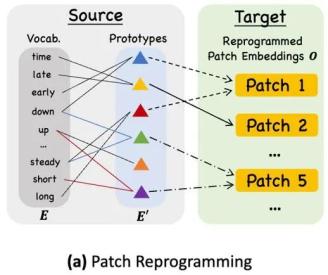
In this work, the author puts forward Time-LLM, which is a general framework of LLM Reprogramming. LLM can be easily used for general time series prediction without any training for the large language model itself. Time-LLM first reprogrammed the input time series data with Text Prototypes, and expressed the semantic information of the time series data by using natural language representation, and then aligned two different data modes, so that the large language model could understand the information behind the other data mode without any modification.

In order to further enhance LLM’s understanding of input time-series data and corresponding tasks, the author puts forward a paradigm of Prompt-as-Prefix (PaP), which fully activates LLM’s processing ability in time-series tasks by adding additional context prompts and task instructions before time-series data representation. In this work, the author has carried out sufficient experiments on the mainstream time series benchmark data sets, and the results show that Time-LLM can surpass the traditional time series model in most cases, and has greatly improved the learning tasks of Few-shot and Zero-shot.

The main contributions in this work can be summarized as follows:

1. This work puts forward a new concept of time series analysis by reprogramming large language model, without any modification to the main language model. The author shows that time series prediction can be regarded as another "language" task that can be effectively solved by ready-made LLM.

2. This work puts forward a general language model reprogramming framework, namely Time-LLM, which includes reprogramming the input time series data into a more natural text prototype representation, and enhancing the input context through declarative prompts (such as domain expert knowledge and task description) to guide LLM to conduct effective cross-domain reasoning. This technology provides a solid foundation for the development of multi-modal time series basic model.

3. The performance of Time-LLM in mainstream forecasting tasks always exceeds the performance of the best existing models, especially in scenes with few samples and zero samples. In addition, Time-LLM can achieve higher performance while maintaining excellent model reprogramming efficiency. Greatly release LLM’s untapped potential in time series and other sequential data.

3. Model framework

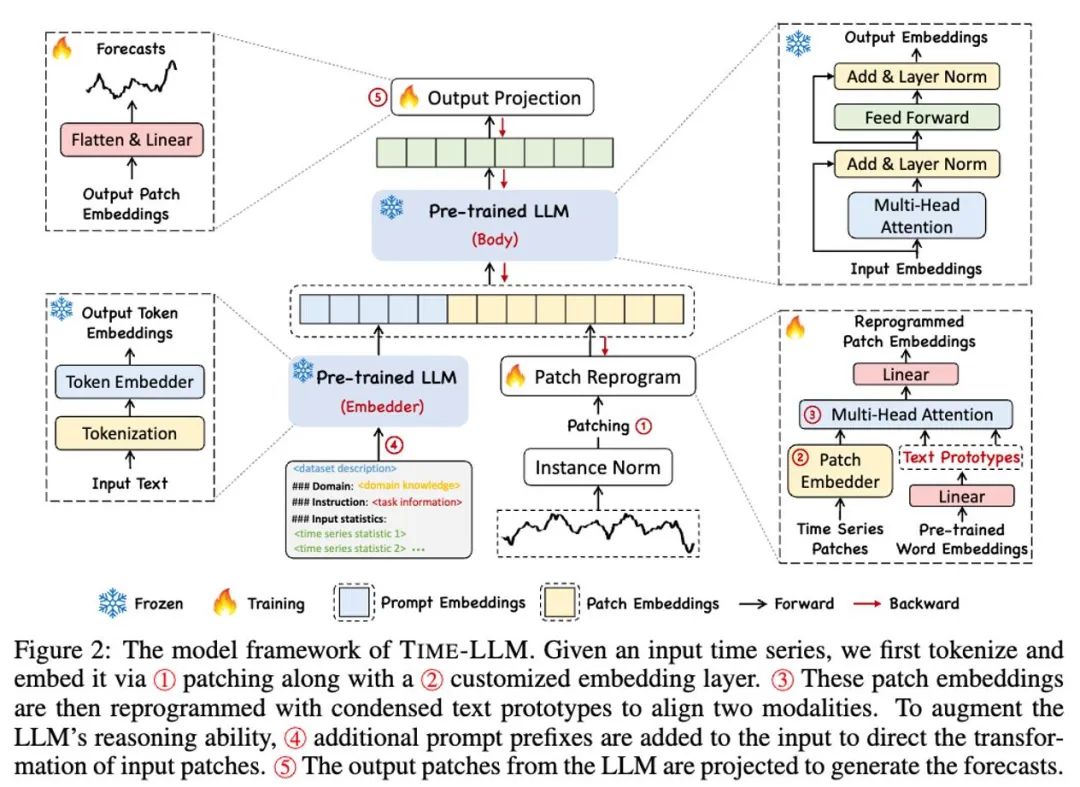
As shown in ① and ② in the model frame diagram above, the input time series data is normalized by RevIN, and then cut into different patch and mapped to the hidden space.

There are significant differences between time series data and text data in expression, and they belong to different modes. Time series can neither be directly edited nor described in natural language, which brings great challenges to prompting)LLM to understand time series. Therefore, we need to align the time series input features to the natural language text domain.

A common method to align different modes is cross-attention, as shown in ③ in the model frame diagram, which only needs to make a cross-attention for the embedding and time sequence input features of all words (in which the time sequence input feature is Query, and the embedding of all words is Key and Value). However, LLM’s inherent vocabulary is very large, so it can’t directly align the time series features to all words effectively, and not all words have aligned semantic relations with time series. In order to solve this problem, this work combines vocabularies linearly to obtain text prototypes, in which the number of text prototypes is much smaller than the original vocabulary, and the combination can be used to represent the changing characteristics of time series data, such as "short rise or slow decline", as shown in the above figure.

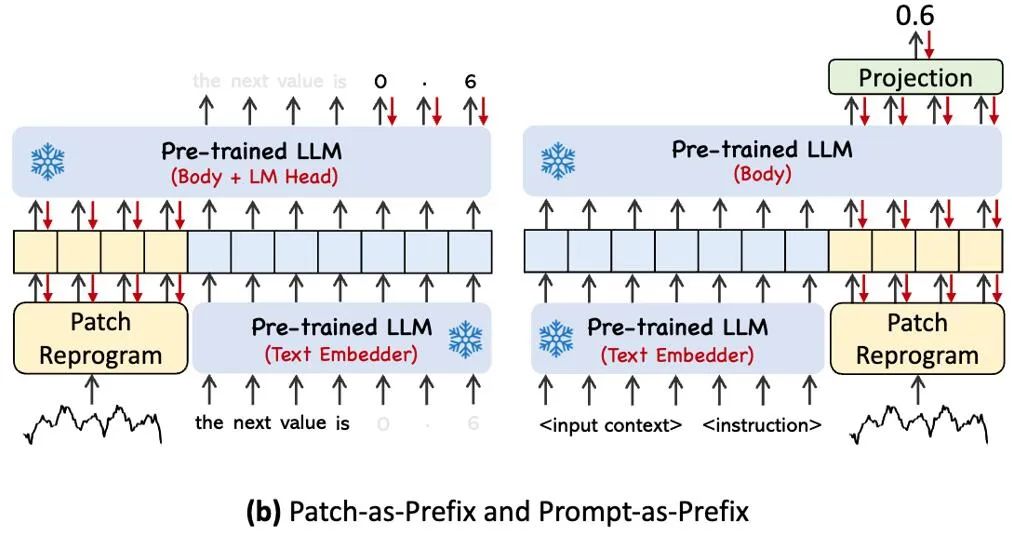
In order to fully activate LLM’s ability to specify time-series tasks, this work puts forward the paradigm of prompt prefix, which is a simple and effective method, as shown in the model frame diagram. Recent progress shows that other data patterns, such as images, can be seamlessly integrated into the prefix of prompts, thus making effective reasoning based on these inputs. Inspired by these findings, in order to make their methods directly applicable to real-world time series, the authors put forward an alternative question: Can hints be used as prefix information to enrich the input context and guide the transformation of reprogramming time series patches? This concept is called Prompt-as-Prefix (PaP). In addition, the author also observed that it significantly improved LLM’s adaptability to downstream tasks and supplemented the reprogramming of patches. Generally speaking, it means that some prior information of time series data set is used as prefix prompt in the way of natural language, and it is spliced with aligned time series features to feed to LLM. Can it improve the prediction effect?

The figure above shows two prompting methods. In Patch-as-Prefix, the language model is prompted to predict the subsequent values in the time series, which are expressed in natural language. This method encounters some constraints: (1) Language models usually show low sensitivity when dealing with high-precision numbers without the assistance of external tools, which brings great challenges to the accurate processing of long-term forecasting tasks; (2) For different language models, complex customized post-processing is needed, because they are pre-trained on different corpora and may use different word segmentation types when generating high-precision numbers. This leads to the prediction expressed in different natural language formats, such as [‘0′,’.’,’ 6′,’ 1′] and [‘0′,’.’,’ 61′], representing 0.61.

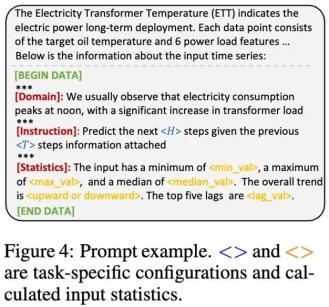
In practice, the author identified three key components to construct effective hints: (1) the context of data set; (2) Task instruction, which makes LLM adapt to different downstream tasks; (3) Statistical descriptions, such as trends and time delays, enable LLM to better understand the characteristics of time series data. The following figure shows an example of a prompt.

4. Experimental effect

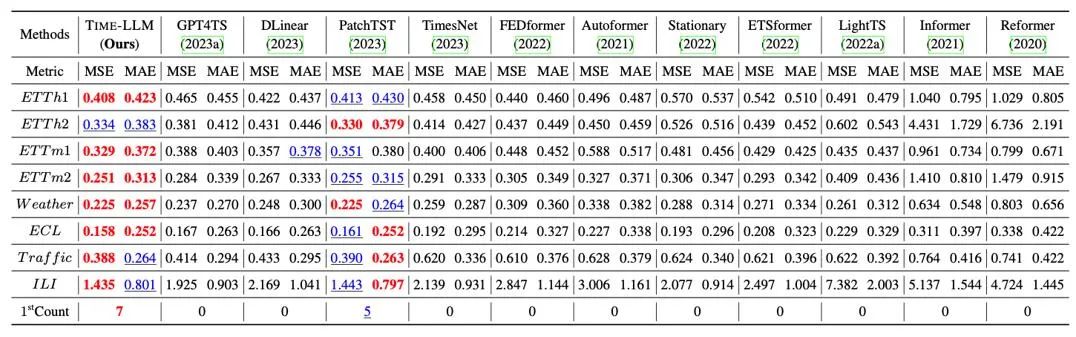
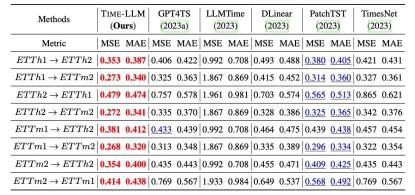
We have conducted a comprehensive test on eight classic public data sets in long-range forecasting. As shown in the following table, the benchmark comparison of Time-LLM is significantly superior to the previous best results in the field. In addition, compared with GPT4TS which directly uses GPT-2, Time-LLM which adopts the idea of reprogramming and prompts as-prefix is also significantly improved, which shows the effectiveness of this method.

In addition, we evaluated the zero-shot learning ability of reprogrammed LLM within the framework of cross-domain adaptation. Thanks to the reprogramming ability, we fully activated LLM’s prediction ability in cross-domain scenarios. As shown in the following table, Time-LLM also showed extraordinary prediction effect in zero-shot scenarios.

Step 5 summarize

The rapid development of large-scale language models (LLMs) has greatly promoted the progress of artificial intelligence in multimodal scenes, and promoted their wide application in many fields. However, LLMs’s huge parameter scale and its design mainly aimed at natural language processing (NLP) scenarios have brought many challenges to its cross-modal and cross-domain applications. In view of this, we put forward a new idea of reprogramming large model, aiming at realizing the cross-modal interaction between text and sequence data, and this method is widely used to deal with large-scale time series and spatio-temporal data. In this way, we expect LLMs to be like a flexible dancing elephant, which can show its powerful ability in a wider application scenario.

Interested friends are welcome to read the paper (https://arxiv.org/abs/2310.01728) or visit the project page (https://github.com/KimMeen/Time-LLM) for more information.

This project has been fully supported by NextEvo, the AI innovation R&D department under the Intelligent Engine Division of Ant Group, especially thanks to the close cooperation between the language and machine intelligence team and the optimization intelligence team. Under the leadership and guidance of Zhou Jun, Vice President of Intelligent Engine Division, and Lu Xingyu, Head of Intelligent Optimization Team, we have successfully completed this important achievement hand in hand.

The National Day box office broke through 2.3 billion, and "As Hard as a Rock" temporarily topped the list.


1905 movie network news According to the data of Lighthouse Professional Edition, as of 17: 22 on October 4, the box office list of new National Day movies in 2023 (including point screening and pre-sale) has reached 2.3 billion yuan. The competition is fierce, and it is temporarily in the top three in the rankings.


The director’s "Rock Solid" continued the box office growth momentum of the previous days, temporarily ranking first with 755 million yuan. The addition of many powerful actors such as,,,,,, adds a lot of highlights to this film. The infighting between Zhang Guoli and Yu Hewei in the play outlines various crises hidden behind the appearance of a prosperous city.


With the theme of the emotional state of contemporary urbanites, "Ex-4: Early Marriage" drives the box office with its high reputation. Meng Yun, who plays, tries a blind date, while Yu Fei, who plays, and his girlfriend create their own "marriage cooling-off period" to preview their marriage life in advance. The audience gained laughter and moved, but also had a deeper understanding of feelings. As of press time, "Ex-4: Early Marriage" has reached 585 million at the box office, temporarily ranking second.


The war giant "Volunteer Army: Attack by Heroes" has always attracted people’s attention with the highest score in the box office list of the new National Day movies in 2023. As of press time, the box office of the film has reached 423 million, temporarily ranking third. As the first part of the trilogy "Volunteers", the film tells the story from the decision to send troops to Chinese people’s Volunteer Army’s entry into the DPRK and the first and second battles in a more grand narrative way. It fills the blank of similar works in conception and perspective.


The box office adapted from real events continued to grow steadily, reaching 311 million, temporarily ranking fourth. The extreme confrontation between harmony and others has become a topic of great interest to the audience. Sports comedies temporarily ranked fifth, with a box office of 91.512 million as of press time.


The noodle culture of "the world in the bowl is wide and the Kun is twisted in the face" swept the world.

  Hollow vermicelli is an ancient traditional pasta snack. There is an instant noodle museum in Yokohama, Japan. Zhang Hui

  As the saying goes: "The heaven and the earth in the bowl are wide, and the Kun is twisted in the face." As a representative of ancient food, noodles have traversed both the east and the west, as well as the ancient and modern times. The Silk Road was once called the "noodle road" because of its spread, and chopsticks in Chinese tableware culture were probably born of it. Until today, noodles are still popular in the east and west, and they have won the top spot in modern fast food culture, and even been sent to outer space.

  All the way to the east, noodle culture swept across East Asia.

  The story of noodles should start from the "noodle empire" — — China said. China has a vast territory. Thousands of years of cooking smoke have bred more than 2,000 kinds of noodles, which has influenced the noodle culture in East Asia. However, neither noodles nor wheat, the main raw material for making noodles, originated here.

  China’s hieroglyph "Mai" originally refers to "people from afar", and when combined with the word "noodle", it becomes "noodle" (the traditional Chinese character of "noodle"), and noodles made of wheat and wheat flour did come from afar thousands of years ago. Wheat, with an annual output of 600 million tons, has become the staple food for 60% of the population on the earth. It was first born in the farming civilization in Mesopotamia 9000 years ago. In 6500 years after its birth, wheat planting technology and flour making technology began to spread from the Middle East to the Mediterranean, across the Balkans and Alps, and eastward to China through Central Asia. Therefore, this "Silk Road" starting from Chang ‘an and passing through Gansu, Xinjiang, Central Asia, West Asia and even Mediterranean countries is also called "Noodle Road".

  Arab merchants traveling along the Silk Road carry dough with them as dry food. Before eating, they divide the dough into small pieces, rub it into strips to dry, and bake it on the fire. This is almost the embryonic form of early noodles in human history. Such noodles entered the mainland of China along the Silk Road and began to flourish in the Central Plains. However, the Central Plains people, who like soup, cooked noodles with water, and when noodles were taken from hot soup, chopsticks were born.

  Although China is not the earliest birthplace of noodles, it is the earliest place where noodles have been discovered. More than 4,000 years ago, a sudden earthquake destroyed a village in the northwest of China, followed by a flood that froze it. More than 4,000 years later, exactly in 2005, archaeologists discovered noodles about 50 cm long and 3 mm wide exposed in the rock stratum in Lajia Village, Qinghai Province, known as "Pompeii, China". But at that time, its name was probably not called "noodles".

  In China, the earliest noodles were called "cakes" or "soup cakes". Qi Min Yao Shu, 1400 years ago, recorded for the first time the "water-inducing method" of making noodles — —

  "It’s as big as a bamboo stick, and a foot is broken. If the plate is flooded, it’s advisable to put your hand on it and cook it as thin as leek leaves."

  "It’s like a big finger, two inches is broken, and it’s appropriate to dip it in a basin. It’s advisable to slap it to the side of the basin by hand and cook it in a hurry."

  To put it simply, "water-led noodles" are noodles that are drawn to the thickness of chopsticks, pinched into a foot shape, and then quickly kneaded into flat strips on the steam of a boiling pot, cooked and topped with chicken soup. The method of making delicious noodles is similar to that of introducing noodles with water, but the shape is more like flat noodles, but the taste is "smooth and beautiful", which is the earliest noodle soup in the Central Plains.

  When noodles were first introduced to Europe, China’s noodles had entered a dazzling period of prosperity. Kaifeng, the capital of the Song Dynasty, was also known as the "noodle capital". This international city with a population of 500,000 (compared with 100,000 in Paris in the same period) saw the earliest commercial street in the world. The restaurants in the commercial street appeared more than 500 years earlier than the large European restaurants. Handmade noodles, knife section, Lamian Noodles … … There are more than 30 mainstream noodle practices in restaurants. Noodles that entered the mainland of China along the Silk Road spread northward and eastward from here, entered Mongolia, South Korea and Japan, and entered Vietnam, Thailand and Indonesia southward. Noodles culture swept across East Asia and Southeast Asia.

  The manual "dough-pressing machine" made by the Han people (putting dough into a groove, opening a number of small holes under the groove, and squeezing the noodles out of the small holes by pressure through the lever principle) is still used in North Korea, Bhutan and other countries. Since the Tang Dynasty, slender noodles have a beautiful meaning of longevity and continuity in Chinese food culture, so a bowl of longevity noodles is indispensable for a birthday girl. The same color head is also popular in Asian noodle circles: South Korea should have noodles at the banquet on the wedding day, which means "grow old together and last forever"; Thailand eats noodles on traditional celebration days in order to "have endless happy events"; Japanese people are popular to eat vegetarian noodles on the seventh day of July to pray for "good luck", and they also eat noodles on New Year’s Eve, which is called "Nianyue Noodles" — — This kind of thin and long food, like a bond, started from China and contacted the kitchens of Asian countries.

  The most typical transmission of pasta culture is Japan. Also in the Song Dynasty, a Japanese monk named "Yuan Er Bian Yuan" (later called "Noodle Monk") returned from Lin ‘an. In addition to the Buddhist scriptures of Zen Buddhism, there is also a design of a grinding machine with wheels driven by waterwheels in his luggage. The technology of grinding noodles from China, together with the fashion of eating noodles, spread to Japanese temple kitchens through Japanese monks. Noodles made of wheat or buckwheat flour, cooked and boiled with Shanghai algae and mushrooms, Japanese monks are only allowed to make a sound when eating noodles, and the spread of noodles from monks to Japanese folk has also formed a unique custom: the louder the sound when eating noodles, the more polite it is.

  All the way west, spaghetti changed from aristocratic cuisine to civilian cuisine.

  Compared with the history of bread in Europe for tens of thousands of years, noodles came late, and spaghetti was first mentioned in a medical book in the 13th century.

  Italy is a unique existence in the European countries where bread is the staple food. They raise the "national noodle" spaghetti to the height of the national symbol. Every day, when it comes to meals, almost the whole country is full of the same thing — — Spaghetti Spaghetti is an important staple food for Italians, so that the appetizer is called "antipasto" (meaning before noodles). It is said that Mussolini, who loves spaghetti very much, promised the soldiers every time he mobilized before the war: "There will be a plate of delicious noodles later."

  Since its birth, there have been hundreds of patterns behind the name spaghetti: fine noodles, spiral noodles, cat’s ear noodles, macaroni … … Add artichokes, meat sauce, mushroom sauce, olive oil or cheese powder ingredients to change thousands of combinations. So who brought this kind of noodles to Europe and changed the diet pattern in Italy and even Europe?

  China people want to believe that it is Kyle Poirot. Born in Venice in the 14th century, this merchant descendant had a prominent family because he was engaged in selling spices. At the age of 15, he came to China to travel around and enjoy the local customs of Chinese culture, and did not return to his native land until ten years later. There is a saying that Kyle Poirot saw all kinds of noodle making when he traveled around China, so he brought the noodle making technology from China back to Italy.

  However, in Kyle Polo’s Travels of Marco Polo, his description of noodles has never been found. On the contrary, in the doctor’s prescription of Genoa, another Italian city, in 1244, historians found the advice that "patients with fragile stomachs should try to eat less Terry". The "Terry" here was proved to be spaghetti, and this record was decades earlier than Kyle Poirot’s return to China. So Kyle Poirot was not the one who introduced noodles to Italy.

  Another story comes from the Italians themselves, who pushed the history of this national food back to the Roman Empire, thinking that Etruscans had already started eating noodles at that time. However, in the archaeological records of Roman diet, only "miscellaneous vegetable soup, seafood, grilled fish and bread similar to pizza" can be confirmed so far, and noodles are still hard to find.

  So the real matchmaker should still be Arabs. Just as Arab merchants introduced noodles to China people on the Silk Road and then introduced them to the Central Plains, in 827 AD, the Aghlabid dynasty in North Africa captured Sicily at the southern tip of Italy, and brought the method of "Persian dried noodles" similar to knife noodles to the island. Dry noodles are a kind of dry food which is convenient to store, and are very suitable for camel traders or Islamic armies who travel long distances. Dry noodles need to be exposed to the sun, and the climatic conditions in Sicily are just right for them. As a result, Italy is not only used to this slender pasta, but also uses the convenience of maritime trade to sell dry noodles that are not easy to deteriorate to all parts of Europe. As a handwritten geography book in Arabia said when introducing Sicily in 1154, "They make linear Itri (spaghetti) here and sell this food to the world."

  Similarly, just like the custom that China people began to use chopsticks after eating noodles, European aristocrats felt embarrassed when eating spaghetti with soup and juice, so they began to use forks. Noodles once again reshaped the tableware culture. But interestingly, Arabs, who are used to grasping food with their hands, began to eat only short noodles gradually for the convenience of eating, but the slender long noodles disappeared from their diet.

  In Europe, even though the price of noodles in the Middle Ages was four times that of bread, people never gave up. Noodles have been a luxury in Europe for more than 400 years, and the groups that can be enjoyed are limited to European popes and nobles, and then slowly expanded to the gradually prosperous middle class. The noodle makers are almost all women, and most of them are nuns from monasteries. Only they can finely knead, cut and dry the dough in such leisure time. Take Italy’s "helicoid" as an example: "The finest, whitest and smallest thing, but it also costs the most. The dough must be kneaded, divided into strips, and then rolled into snails by skillful girls. "

  In 17th-century Italy, spaghetti was introduced to all walks of life from aristocratic high-class cuisine, from the kitchens of nobles and bishops to mobile stalls on the street. The improvement of kneading machines in the 19th century, the progress of milling technology in the 20th century and the appearance of electric engines made the price of wheat drop continuously. The "white skill" of noodles became a "white processing industry", and flour and noodles became cheaper day by day. Industrially produced noodles make it a popular diet all over the world, especially in big cities with rapid population concentration.

  Instant noodles, a fast food in modern society.

  Edo was a rapidly expanding metropolis in the 18th century, with a population of nearly 1 million at its peak. In order to ensure the loyalty of local nobles, Tokugawa asked Daming to live in Edo every two years, and their wives and concubines had to stay in Edo as hostages. Daming and his family needed a decent palace to live in Edo. At that time, Edo City gathered the most exquisite craftsmen and craftsmen in the country, and built buildings and streets. These industrial and commercial classes, known as "machi people", have promoted Japanese pasta culture, among which soba noodles are the most typical.

  A large number of civilians live in narrow wooden "town houses", and cooking with a fire is easy to cause fires. The needs of "town people" are often solved in the form of eating outside, and the mobile food stalls called "houses" are their "kitchens and restaurants". In 1804, 6,065 snack bars were registered in Edo. In addition to traditional Japanese food such as tempura and sushi, these snack bars also sell instant buckwheat noodles. After ordering, the buckwheat noodles that have been watered in advance are gently picked up from the pot, and a spoonful of boiled soup is added to the bowl, which can be handed to the diners on the side (they usually stand at the stall and finish a bowl of noodles quickly). The whole process takes less than three minutes, which can be said to be the originator of the fast food industry.

  Standing to eat noodles can also be seen everywhere in Japanese ramen restaurants that once rose after World War II. Roll the noodles into long strips and fold them in half. Grab one end with one hand and pull the other hand in the middle. Dance your hands back and forth to tighten the dough and then overlap. Every time it is pulled, the number of noodles is multiplied by two, and it is also thinner. Lamian Noodles’s technology originally originated in Gansu, China, and local alkali is the best material to strengthen the elasticity of noodles. Japan does not produce alkali, but learns from China’s Lamian Noodles method to add alkaline water, so Lamian Noodles was originally called "Chinese Lamian Noodles" in Japan. In Japan after World War II, millions of people poured into a metropolis like Tokyo from the countryside because of post-war reconstruction. Like the laborers in the Edo period, their houses were narrow and it was difficult for them to have their own kitchens and cooking time, so the new Japanese Lamian Noodles appeared like mushrooms after rain. No matter in the period of rapid economic rise or after the bursting of the economic bubble, Lamian Noodles fever remained in the limelight. At present, there are 40,000 Lamian Noodles shops in Japan, including thousands in Sapporo, the capital of Lamian Noodles. When a noodle restaurant arrives for a meal, there are often long queues.

  Noodles are very popular. Besides being delicious and cheap, there is another beauty. The beauty of this is that it can be prepared in advance, and it is an ever-changing taste to cook temporarily with different toppings and soups, so it has an innate advantage in Asian fast food culture. However, there is a Japanese named Ando Baifu who hopes to eat noodles more quickly. The standardized actions of two businesses, heating with water and mixing seasonings, can also be completed instantly in an ordinary family without or without using the kitchen.

  He tried repeatedly in the kitchen in his backyard, and finally found that the moisture in noodles could be completely drained by frying (in medieval Italy, they spent several days or even a week drying), so that noodles could be preserved for a long time, and at the same time, the fried holes could quickly absorb water when injecting water. In 1958, Ando Baifu introduced the first batch of instant noodles to the market with the product of "Chicken Lamian Noodles", and with the help of the introduction of TV in 1959 and the offensive of Tokyo Olympic Games in 1964, this kind of "cheap, delicious and easy to cook" noodles was publicized. Especially, in the fire of Osaka Chihiro Department Store in 1972, free cup noodles were provided for firefighters, which made this instant noodle deeply rooted in people’s hearts. The Japanese media even praised Ando Baifu’s instant noodles as the greatest invention in Japan in the 20th century, and Ando himself benefited a lot from it. The Nissin Group founded by him now has an annual income of 250 million euros. According to the statistics and prediction of Christopher Nahart, the author of The Book of Pasta, "In 2005, human beings consumed 85 billion portions of instant noodles a year, and everyone ate 12 cups on average. It will reach 100 billion in 2010. " Whether young people living alone, Antarctic delegations or even astronauts in the space station are enjoying a bowl of noodles quickly in the form of instant noodles.

  Passing the East and the West along the Silk Road, with the ever-changing food styles in various places, has also grasped the rhythm in the rise of modern cities — — Noodles have been developing beyond imagination for more than 4,000 years. It is the best footnote to "dry Kun in the face" that lasts forever.

  Variety, Shanxi people’s pasta.

  If China is the "country of pasta", then Shanxi is the "city of pasta".

  Noodles are the staple food of Shanxi people, and they are often eaten three times a day. Shanxi people are good at dough making techniques, such as knife cutting (first rolling the dough thin, then cutting it into strips with a knife), pulling pieces (tearing the rolled dough into pieces), cat ears (first tearing the dough into pieces, and then rubbing it into a cat’s ear shape with the thumb tip on the palm of your hand), picking tips (unique to Shanxi, using a chopstick to pull out strips from the kneaded soft dough and directly put them into the pot), and Lamian Noodles. Direct cooking), river fishing (scraping noodles with a scraper) and spiral noodles (kneading into short spirals with the palm of your hand), the flour used for making noodles, such as wheat, rye, rye, barley, buckwheat, potato, corn, all kinds of beans and rice, is combined with steaming, frying, roasting, frying, stewing, frying and pasting. According to Beijing Daily

False eyelashes "become warped" and the industrial vitality. Qingdao false eyelashes enterprises exceed 70% in the country.

In recent years, a "face value economy" with aesthetics as the core is quietly emerging. As the finishing touch of eye makeup, false eyelashes have become the favorite of more and more beauty lovers. According to the data, in 2023, the market scale of false eyelashes on Taobao, Tmall and Tik Tok platforms reached 2.84 billion yuan, up 111.5% year-on-year.

According to the report of Voice of China, Central Radio and Television General Station, an ordinary northern city supplies 70% of the world’s false eyelashes, and its market value is as high as 10 billion yuan. This place is Pingdu, Shandong. According to enterprise survey data, there are 2,954 false eyelashes-related enterprises in Shandong, accounting for 89.76% of the national stock. Among them, there are 2,469 false eyelashes-related enterprises in Qingdao, a prefecture-level city under pingdu city, accounting for 83.58% of the relevant enterprises in Shandong and 75.02% of the relevant enterprises in China, ranking first in the country.

According to the enterprise survey data, there are 3,291 enterprises related to false eyelashes in China. In the past ten years, the false eyelashes industry has gone through the initial stage and the growth stage, and the registration volume of related enterprises has shown an overall growth trend. In 2023, 676 enterprises increased by 48.57% year-on-year, hitting a new high in the past ten years.

There are 3291 enterprises related to false eyelashes in China.

According to the enterprise survey data, there are 3,291 enterprises related to false eyelashes in China. In the past ten years, the false eyelashes industry has gone through the initial stage and the growth stage, and the registration volume of related enterprises has shown an overall growth trend. In 2023, 676 enterprises increased by 48.57% year-on-year, hitting a new high in the past ten years. Up to now, 439 related enterprises have been registered this year, of which 431 were registered in the first seven months, an increase of nearly 10% over the same period last year.

The stock of related enterprises in Qingdao accounts for 75.02% of the whole country.

Enterprise survey data shows that from a regional perspective, pingdu city is the industrial capital of false eyelashes in China, accounting for 70% of the global total. With its perfect and mature industrial chain, there are 2,954 false eyelashes-related enterprises in Shandong, accounting for 89.76% of the national stock. Among them, there are 2,469 false eyelashes-related enterprises in Qingdao, a prefecture-level city under pingdu city, accounting for 83.58% of the relevant enterprises in Shandong and 75.02% of the relevant enterprises in China, ranking first in the country. Text/letter network reporter

Reporting/feedback

The processing results are coming! More insider exposure of the arrogant tour guide incident in Guilin, Guangxi

       CCTV News:"Life is not just about the present, but also about poems and distant fields." Travel has become an excellent choice for many people after work in the Dragon Boat Festival holiday just past. Everyone hopes to gain a good mood through travel. However, some netizens suffered an unpleasant trip a few days ago, because a mad tour guide in Guilin, Guangxi, said to them with a bad attitude: "Now we get off the bus and stay in it for 20,000 yuan an hour. Go! Get off! "

       This incident caused widespread concern after exposure. Yesterday evening (June 11th), Guilin Municipal Bureau of Culture, Radio, Film and Tourism also responded to this incident on its official Weibo and official website, saying that after preliminary investigation and verification, the words and deeds of Zhao Moumou, the tour guide reflected by netizens, were basically true. According to the evidence currently available, the tour group was a "four-night and five-day bus tour group" from Hunan to Guilin, with a total of 55 people in the group. The tour time was from May 30th to June 2nd.

one

       Just this afternoon, the incident made the latest progress. The Guilin Municipal Bureau of Culture, Radio, Film and Tourism announced the results of the investigation and handling. After investigation and verification, it was found that the tour group was organized by a beauty brand in Hunan on suspicion of violating the rules. The tour guide involved was in Guilin, and the tour guide used rude language to treat tourists, which had a very bad influence. Zhao Moumou, the tour guide involved, was instructed to apologize to the tourists and revoke his tour guide card, and at the same time, it was included in the bad information of tourism management and service.

       As a matter of fact, every holiday, tourism chaos such as tour guides’ compulsory consumption happens from time to time. For this reason, in the first quarter of last year, the Ministry of Culture and Tourism launched the "Sword Action" to rectify the national tourism market order, aiming at the vicious incidents such as tour guides’ compulsory or disguised forced consumption of tourists and "black guides" beating tourists. During this period, 11,253 tourism enterprises, 2,942 tourism teams and 8,596 tour guides were inspected.

       In addition, the relevant state departments also established a "blacklist" system in 2015. In the first batch of "blacklists" in that year, seven tour guides were listed for arranging services for people who did not obtain a tour guide card, coercing tourists to shop, changing their travel itinerary without authorization, and insulting tourists. Among these seven people, the light ones were fined ranging from 10,000 yuan to 50,000 yuan, and the severe ones were revoked.

       We also remind you that you must report to the relevant departments in time if you encounter cheating, forced shopping and other behaviors during your trip.

China youth in the eyes of foreign students: patriotic, enterprising, warm and friendly

  China Daily Online, May 4th (Reporter Nisina Sun Ruonan) "Youth is like early spring, like the morning sun, like the budding of a hundred flowers, like a sharp sword, the most precious period of life. Youth is to society what fresh and lively cells are to people. " Today is the 99th anniversary of the May 4th Movement. We walked into the campus and interviewed six foreign students. Come and see what kind of youth China youth represents in their eyes!

China youth in the eyes of foreign students: patriotic, enterprising, warm and friendly

  Mike, a student from the Republic of Burundi: enthusiastic and enterprising.

  They are very enthusiastic, especially in learning. They are willing to learn from scratch and are enthusiastic about new things and new knowledge. Compared with young people in other countries, young people in China are still very competitive. Although young people in our country will study hard, the efforts of young people in China have reached another level, far exceeding those in our sense.

China youth in the eyes of foreign students: patriotic, enterprising, warm and friendly

  Afghan student Hari: Friendly and hard-working.

  Students in China work harder than Afghan students. They take their studies very seriously every day. I think students in China are very good. Young people in China are very friendly and helpful to foreigners. Whenever I have any questions, just ask them and I will get very effective answers and help.

China youth in the eyes of foreign students: patriotic, enterprising, warm and friendly

  Bangladeshi student mishu: Passionate about spreading China culture.

  Young people in China are very willing to learn about people and cultures of other countries. They are also very patriotic and will actively show every aspect of China culture to foreign friends on different occasions. Young people in China are always very friendly, diligent and patriotic, and we also love China.

China youth in the eyes of foreign students: patriotic, enterprising, warm and friendly

  French student Ala Edin: Excellent.

  Generally speaking, the young people in China in my impression are always very friendly. Whenever I compare the youth in China with those in other countries, I think of very positive and positive things. If I can use one word to describe the youth in China, it is "excellent".

China youth in the eyes of foreign students: patriotic, enterprising, warm and friendly

  Pakistani student Ba Qiming: Work hard

  They are very energetic and responsible. The young people I know in China are very, very hard-working, but what impresses me is that they are usually studying at high intensity. I think they should better balance their study and life. Some young people in China are very forgetful in learning and have a strong sense of time. For example, young people in our country may study for two hours and play for two hours, but many young people in China will spend all their time on their studies. They think that playing for two hours is a waste of time. To tell the truth, they are my motivation to learn.

China youth in the eyes of foreign students: patriotic, enterprising, warm and friendly

  Korean student Shen Mei (right): Love learning.

  Young people in China love learning, live a regular and healthy life, go to bed early and get up early, and get up on time for breakfast every day. Moreover, young people in China are very frugal. When they go out for a party, they will pack up the rest of the food and take it away after eating. Young people there rarely do this.

Wanda plaza, why are you driving less and less?

Wang Jianlin’s Wanda has been a bit "troublesome" recently.

On the one hand, wanda plaza all over the country is constantly "selling", and on the other hand, it has been "debt collection" by Yonghui and Suning. In particular, Wanda Commercial Management’s trump card asset, wanda plaza, began to decrease.

First, the opening speed slows down, or the annual target cannot be achieved.

Under the dual pressure of listing and debt, Wanda Commercial Management has slowed down its expansion.

Before 2023, Wanda maintained the opening speed of at least 40+ commercial projects every year: in 2016, a total of 56 were opened, including 20 light assets; 50 seats opened in 2017; 52 seats opened in 2018; 41 seats opened in 2019; 45 seats will be opened in 2020; 51 seats were opened in 2021; 55 buildings were opened in 2022.

However, since 2023, Wanda’s listing pressure has increased and it is facing a huge "gambling agreement crisis". Although Wanda has already started to go to real estate, which has eased the pressure on development funds and expanded the market scale by light asset export management, it has also begun to reduce the market supply.

In 2023, Wanda opened 29 new commercial projects in China, including 28 wanda plaza and 1 Wanda Mao. In 2023, Wanda sold at least 9 wanda plaza.

In 2024, according to the statistics of Lianshang.com at the beginning of the year, it is estimated that 32 wanda plaza projects will be opened throughout the year, and the expansion speed will slow down. In fact, since 2023, Wanda has not disclosed its annual opening target. So, what is the situation completed this year?

According to the latest statistics of lianshang. com, by the end of October, there were 11 wanda plaza businesses in China. According to the plan, 11 wanda plaza will be opened in November and December.. It is estimated that the number of opening businesses in the whole year will be around 27, which will not only fail to meet the statistics at the beginning of the year, but may also set a lower opening volume than in 2023.

In the pre-opening table at the beginning of the yearhorseWanda plaza in Anshan County, Fenghua wanda plaza in Huzhou, wanda plaza in Hangu, Tianjin and wanda plaza in Lianjiang, Zhanjiang.There is no news about the progress of the project at present.Wanda plaza, the south city of Lishui, has become the future city of Lishui., which opened in August this year.

Wanda plaza, Qianjiang, Hubei and wanda plaza, Linping, Hangzhou were originally scheduled to open in October, but it is likely to be postponed until the end of the year.

In addition, two projects, Xiangyang Xiangzhou wanda plaza and Wenzhou Ruian wanda plaza, are scheduled to open at the end of the year, but there is no exact latest news at present, and it is not known whether they can open on time. Originally scheduled to open on National DayLu ‘an Yu ‘an wanda plazaIt has been confirmed that it will be postponed until 2025.

However, Wanda is still the largest commercial real estate management company in China.

According to the "TOP100 Shopping Center Enterprises in China in 2023" published by CCFA in June this year, by June 30, 2024, Wanda Commercial Management had 497 shopping centers (wanda plaza) with a total construction area of 68.98 million ㎡.

Wanda Commercial Management achieved an operating income of 52.325 billion yuan in 2023, a year-on-year increase of 6.11%; The net profit was 8.511 billion yuan, a year-on-year decrease of 31.9%.

Second, at least 30 wanda plaza have been sold.

Wang Jianlin mentioned at Wanda’s 2024 annual meeting that one of the tasks in 2024 is to reduce costs and increase efficiency.

In 2024, wanda plaza was frequently sold.

According to the statistics of Lianshang.com, from May 2023 to now, there have been at least 30 wanda plaza in China.(including Nanjing Wanda Mao)Be sold and renamed. Many of them are light asset projects, such as Hepu wanda plaza in Beihai changed its name to Hepu Commercial Center, Midea wanda plaza in Shunde, Foshan changed its name to Yueran Plaza in Shunde, Fengcheng wanda plaza changed its name to Hengtong Plaza in Fengcheng, Baihuting wanda plaza in Fuzhou changed its name to Jixiang Tiandi, and Fuzhou Gaoxin wanda plaza changed its name to Xianghe Tiandi.

Since 2024, the number of sales has reached 21. Recently, Wanda also sold Nanjing Wanda Mao, which is the first time to sell Wanda Mao products.

Nanjing Wanda Mao opened on June 1, 2018, gathering 228 merchants, including 9 major stores such as Wanda Studios, Wanda Baby King, Yonghui Supermarket and Decathlon. On the first day of opening, the passenger flow exceeded 260,000.

However, in September this year, Nanjing Wanda Mao Investment Co., Ltd. experienced industrial and commercial changes, and Dalian Wanda Commercial Management Group Co., Ltd. withdrew from the ranks of shareholders and added Kunhua.(Tianjin)Equity investment partnership(limited partnership)As a shareholder and wholly owned, at the same time, many key personnel have also changed. So far, Nanjing Wandamao is owned by new china life insurance co Co., Ltd. and CICC Capital Operation Co., Ltd. with 99.99% and 0.01% respectively.

According to the data, Nanjing Wanda Mao, which is mainly involved in the transfer of assets, is Wanda’s first large-scale cultural tourism project in Nanjing, with a total investment of 40 billion yuan and a total construction area of about 307,000 square meters.

At the same time, the first wanda plaza in Chengdu was also sold in October, which is still a masterpiece leading Wanda’s third-generation commercial complex.

Chengdu Wanda Commercial Plaza Investment Co., Ltd. suddenly changed its business, and Dalian Wanda Commercial Management Group, the original shareholder, withdrew and was replaced by Kun Hua.(Tianjin)Equity investment partnership(limited partnership)Sole proprietorship. Like Nanjing Wanda Mao, the boss behind this private equity fund is still New China Life Insurance with the background of central enterprises.

Chengdu Wanda Commercial Plaza Investment Co., Ltd. registered in Jinhua Road, Jinjiang District, Chengdu, and its Chengdu Jinhua wanda plaza opened at the end of 2007, with a commercial area of 180,000 ㎡, including 400,000 ㎡ apartments and office buildings. It is the first Wanda large-scale complex in Chengdu.

According to industry insiders, Lianshang. com revealed that the heavy assets businesses held by Wanda are all on the shelves, waiting for buyers.

Third, Yonghui and Suning "creditors" came to the door

In the past, investors who believed in Wang Jianlin were also looking for "debt" at any time.

The attack of "creditors" began in Yonghui.

On October 10, Yonghui Supermarket announced that the company had previously sent to Dalian Yujin Trading Co., Ltd.(referred to as "Dalian Yujin")The shares held by Wanda Commercial Management were sold, and the transfer price was about 4.53 billion yuan, which was paid by Dalian Yujin in eight installments. However, Dalian Yujin did not pay RMB 300 million for the fourth equity transfer before September 30 this year as agreed, which constituted a breach of contract.

Therefore, Yonghui Supermarket decided to send a notice of accelerated maturity to Dalian Yujin and the guarantors Wang Jianlin, Sun Xishuang and Dalian Yifang Group, demanding immediate payment and assuming joint and several liability for guarantee. It is worth mentioning that Sun Xishuang, the actual controller of Dalian, is a good friend of Wang Jianlin for many years.

On the evening of October 22nd, an arbitration announcement issued by ST Tesco showed that Suning.cn requested to award Dalian Wanda Group Co., Ltd. a share repurchase payment of 5.04 billion yuan to Suning.cn Group Co., Ltd. and its subsidiary Suning International Group Co., Ltd.

At the same time, it is requested that Wanda Commercial Management be jointly and severally liable for the above payment obligations of Wanda Group. At present, this arbitration request has been accepted by China International Economic and Trade Arbitration Commission.

Suning.cn believes that Wanda Group and Wanda Commercial Management violated the provisions of the Strategic Cooperation Agreement and triggered the share repurchase clause in the Strategic Cooperation Agreement. Wanda Group and Wanda Commercial Management refused to correct and delay the share repurchase, so based on the actual situation, they applied to Trade Zhong for a ruling according to the provisions of the Strategic Cooperation Agreement, requesting that Wanda Group and Wanda Commercial Management buy back some shares and pay the corresponding share repurchase money.

The "contradiction" between Suning and Wanda comes from Wanda’s listing gambling agreement.

In 2016, Wanda Commercial Management, which was also called Wanda Commercial at that time, chose privatization. According to the Wanda Commercial Privatization Project Book circulated at that time, the agreement signed by Wanda Commercial and investors stipulated that Wanda Commercial planned to be listed on the mainland main board market before August 31, 2018.If it fails, Dalian Wanda Group will buy back all the shares and pay 12% and 10% simple interest to overseas and domestic investors respectively.

However, Wanda’ s listing failed to meet expectations, and it was re-organized in 2018.Tencent, Suning.cn, JD.COM Group and Sunac China injected capital into Wanda again.Among them, Suning.cn contributed about 9.5 billion yuan, and Suning International held 4.02% of Wanda Commercial Management.

The details of the Strategic Cooperation Agreement have not been made public in the market, but there is clear insider information that all parties have agreed that Wanda should complete the listing before October 31, 2023. If the conditions are not met, Wanda should pay the repurchase money to investors.

However, it is not clear whether this provision really exists. Therefore, after the incident that Suning directly asked Wanda for the buyback money, it was also reported that an "insider close to Wanda" said that according to the investment agreement signed by both parties, Suning’s reason for asking Wanda to buy back the shares could not be established, and Wanda did not have the so-called breach of contract.

Obviously, the focus of the debate between the two sides is whether there is an "equity repurchase clause". However, no matter what the truth is, the pressure on Wanda Commercial Management is only a lot more.

[Going to the Grassroots in the New Year] Hao Jiping, member of Chinese People’s Political Consultative Conference: The quality of the proposal is the lifeline of performing his duties.

  [Going to the Grass-roots Level in the Spring Festival and Performing the Duty of Delegates]

  Just after the Spring Festival, although the school has not started, Hao Jiping, member of Chinese People’s Political Consultative Conference and vice president of Xi ‘an University of Architecture and Technology, is busy. The two sessions of the National People’s Congress are just around the corner. He not only combed and summarized his experience in performing his duties in the past year, but also kept thinking, brewing and perfecting this year’s proposal.

  "I have gained a lot." Hao Jiping summed up his performance as a member of Chinese People’s Political Consultative Conference in the past year.

  At the two sessions last year, Hao Jiping submitted six proposals around his major and work, not only about promoting steel structure buildings, but also about improving the evaluation criteria of scientific research achievements. In July, he submitted a biweekly forum for Chinese People’s Political Consultative Conference on "Standardizing the soil pollution remediation industry and preventing the PPP model from increasing government debt". In August, as a member of Chinese People’s Political Consultative Conference, he was hired by the Ministry of Public Security as one of the 110 supervisors of Party style, political style and police style in China, and then made more than 10 suggestions on traffic problems in Xi ‘an. In September, Chinese People’s Political Consultative Conference accompanied a delegation of Shaanxi Provincial Committee members to inspect the implementation of the "Thirteenth Five-Year Plan" major projects in Shaanxi. In October, I participated in the inspection of Shaanxi letters and visits by the Central Letters and Visits Inspector Group … …

  Hao Jiping was deeply impressed by his visit to Shaanxi’s "Thirteenth Five-Year Major Project Implementation". In just one week, he visited the intercity rail transit project from Xi ‘an North Station to Xi ‘an Airport and the construction of Yinxi high-speed rail project, the reconstruction and expansion project of Shaanxi History Museum, the protection project of Chang ‘an site in Han Dynasty, the reconstruction and expansion project of Xi ‘an Beilin Museum, the large aircraft project of aviation industry Xi ‘an Aircraft Industry Group Co., Ltd. and Shaanxi Automobile Holding Group Co., Ltd.

  "Although I am in Xi ‘an, I used to have limited knowledge of such projects around me. This time, every time I went with the group, I was excited and deeply proud of the achievements China has made in the 40 years of reform and opening up. " Hao Jiping said that through a series of solid investigations and investigations, he suggested increasing the research and development of key technologies of modern industry, especially changing and improving the key links of current research and development topics, such as topic selection, project establishment, inspection and acceptance, attaching great importance to the transformation of scientific research achievements, and earnestly strengthening the leadership over the transformation of scientific research achievements.

  What is the most important duty and mission of Commissioner Chinese People’s Political Consultative Conference? "Come up with a proposal that can truly reflect the voice of the masses." Hao Jiping believes that the quality of the proposal is the lifeline of his performance.

  "This is what I think and do all the time." Hao Jiping said that Committee member Chinese People’s Political Consultative Conference’s performance of duties permeates all aspects of his work, and the information collected at any time and place may become a part of his proposal. He said that the teachers of Xi ‘an University of Architecture and Technology are also willing to give him advice. "I will also collect social conditions, public opinions and proposals through the United Front Work Department of the school, the school office and the community."

  Cherishing the quality of the proposal, Hao Jiping set his own performance requirements — — "No research, no speech". He hopes that through full investigation, he can listen to the voices of the grassroots and make the suggestions well-founded. Therefore, the proposals submitted by Hao Jiping are all in the field of architecture and education that he has been deeply involved in for many years. "Members should not only write proposals from a personal point of view, but also pay attention to social conditions and public opinion, listen to the voices of ordinary people, and collect and sort out information to write proposals in combination with their own experience in the field of work." Hao Jiping said.

  As the vice chairman of Shaanxi Provincial Committee of NLD and the president of china construction metal structure association, during his tenure as a member of the 12th Chinese People’s Political Consultative Conference Committee, he researched and completed the Proposal on Improving the Quality of Postgraduate Education in China, which comprehensively and systematically analyzed and summarized the problems existing in postgraduate enrollment. He believed that under the current national unified examination mode, the talent selection mechanism was too rigid, and the cost and risk of examination organization were high, which was not conducive to the selection of outstanding talents with innovative comprehensive quality potential in colleges and universities. Therefore, he called for the reform of postgraduate enrollment methods and the implementation of independent enrollment in colleges and universities under the application assessment system. The proposal was compiled by the Shaanxi Provincial Committee of the NLD and the Central Committee of the NLD, submitted to the Chinese People’s Political Consultative Conference Conference, and was rated as an excellent proposal of the 12th National Committee of the Chinese People’s Political Consultative Conference.

  Regarding this year’s proposal of the two sessions, Hao Jiping told reporters that he still pays attention to education, undergraduate education and personnel training, and how Chinese colleges and universities can cultivate socialist builders and successors with all-round development in morality, intelligence, beauty and labor.

  Reporter’s notes

  Only by solid research can we find the real problem.

  In the process of being interviewed by reporters, the word that Committee member Hao Jiping said the most was "investigation".

  He said that only through solid investigation and study can we find the real problems and find out the causal relationship behind complex things. A series of investigation and research activities last year made him more and more aware of the importance of research. Hao Jiping said: "Some big projects and projects that attract worldwide attention are close at hand, but without in-depth investigation, it is impossible to have a systematic and all-round understanding and understanding. If you don’t understand, how can you know, not to mention valuable suggestions. "

  Without understanding, it is also difficult to have an objective evaluation. After participating in the inspection of Shaanxi’s letters and visits by the Central Letters and Visits Inspectorate, Hao Jiping found that the strictness and seriousness of the inspector’s work far exceeded his imagination. "They don’t shy away from problems, they don’t shy away from problems, they are real swords and guns, and they go straight and straight, that is, they want to solve practical problems and do practical things for the people."

  Undoubtedly, investigation and study are the foundation of seeking something and the way to accomplish it. Only by going to the front line to investigate and obtain first-hand information can we think about what the people think, worry about what the people are anxious, and solve the most direct and realistic interests that the people are most concerned about. It can be said that as long as you work hard, a convincing and high-quality proposal will be born.

  In-depth and meticulous investigation is the basis and premise of becoming a qualified member of Chinese People’s Political Consultative Conference. However, there are many questions about how to use the survey results and from what angle to understand them. "An excellent proposal can’t be confined to one store and one household. Committee member Chinese People’s Political Consultative Conference must consider the issue from the overall situation of the country and stand on the macro level in order to put forward suggestions that really benefit the country and the people."

   (Reporter Jin Haotian)

These 15 kinds of animals can be called "living fossils" of animals!

1.png

The news of Youth Science Pictorial is called "living fossil" because other species similar to this creature only exist in fossils, and there are no other existing similar species. "Living fossil" creatures have survived major extinction events and retained their original characteristics. The following 15 kinds of animals can all be called "living fossils"!

earth pig

2.png

The aardvark, also known as the African anteater, is a burrowing animal that moves at night, and it is also the only animal in the Cladocera. From a genetic point of view, the aardvark can be called a "living fossil" because of its chromosome arrangement. Elephants can be regarded as relatives of aardvark, although the kinship is very far away.

lesser panda

3.png

These lovely animals come from the temperate forests of the Himalayas. Although they have "panda" in their names, they have almost nothing to do with giant pandas. Their lineages are more similar to those of bears and skunks, weasels and raccoons, but they do belong to a separate species. If you have to ask what it has to do with giant pandas, it may be that they all like to eat bamboo, but there is no evolutionary relationship.

Beaked-headed lizard

4.png

Wedge-toothed lizard, two lizard-like animals, is the only representative of the remains of coracoids that appeared in the early Triassic, and is called "living fossil". It is the only surviving reptile of the beak leader. Only found in some small islands in New Zealand.

nautilus

5.png

Nautilus is a marine mollusk, which has experienced hundreds of millions of years of evolution on the earth, but its shape and habits have changed little. It is called "living fossil" in the ocean and has high value in studying biological evolution and paleontology.

Purple frog

6.png

Purple frog is a kind of frog with purple body. It belongs to a frog that only exists in Seychelles. Its mouth is very similar to that of a pig, and it spends most of the year underground at a depth of 4 meters. This frog belongs to a branch of a special frog that lived in the ancient dinosaur period. Purple frogs were only discovered in India in 2003 because they live underground, and they only appear for two weeks in the rainy season, and they have been living invisibly at other times.

platypus

7.png

The platypus is one of the most primitive mammals. It is an incompletely evolved mammal with very few species. It is the only animal in the same genus and one of the lowest mammals. The platypus appeared 25 million years ago and still lives in Australia. Due to the small number and distribution of platypus, no subspecies have been found yet.

Mantis shrimp

Mantis shrimp is neither a shrimp nor a mantis, and has not changed in its 400 million years of evolution. They usually appear in all kinds of beautiful colors, and are famous for their powerful pincers. They are competitive in character, so you should not provoke them easily. But they also have a gentle side. Some mantis shrimp will be monogamous and stay with their partners for 20 years. They also have the most advanced eyes in the animal kingdom, which can distinguish 12 colors and various forms of polarized light. In contrast, humans can only distinguish 3 of them.

hagfish

9.png

These animals look like sticky eels, but many experts don’t think they are fish. In fact, some taxonomists are hesitating whether they belong to vertebrates. When blind eels are threatened, they will secrete mucus to help them escape the pursuit of natural enemies. From the evolutionary point of view, their appearance can be traced back to 330 million years ago, and they represent an important life connection between vertebrates and invertebrates.

hoatzin

10.png

Musk pheasant is called because it has a strong musty smell in its body. The classification of this species is controversial, and it is related to both Cudraformes and Chicagoformes. Very good at climbing, the young bird’s forelimb has two claws, similar to Archaeopteryx and Confucius bird, but it is not the original character, but a special adaptation to climbing life.

koala

11.png

Koalas, also known as koalas, are Australia’s national treasures, as well as Australia’s peculiar and precious primitive arboreal animals. But koalas are not Xiong Ke animals, and they are far apart. Xiong Ke belongs to Carnivora, while koalas belong to Marsupials. They have existed on the earth for at least 20 million years. At that time, they lived in tropical rain forests instead of eucalyptus forests as they do now.

Pignose turtle

12.png

Pig-nosed turtle is the only species of the genus Trionychus belonging to Trionychidae. Pig-nosed turtle is a highly aquatic freshwater turtle, which lives in water all the year round except spawning, so its limbs are specialized into flippers like turtles, which is unique among freshwater turtles.

Limulus amebocyte lysate [hü u]

13.png

Horseshoe crab is also called horseshoe crab because it looks like both shrimp and crab. Their ancestors first lived in Paleozoic shallow waters. Horseshoe crab has changed little in the past 445 million years, and it is an animal as old as trilobites.

goblin shark

QQ Pictures 20171013100609.png

The sword-nosed shark lived in the Cretaceous period. Their appearance is very similar to that of the existing Eupatorium odoratum, so some scholars reclassified Eupatorium odoratum into the genus Eupatorium odoratum. However, most shark experts believe that they are sufficiently different to form another genus. The sword-nosed shark has a long flat kiss, sharp and tapered teeth, which is very suitable for catching fish or tearing open prey.

Elephant shrew

15.png

Elephant shrews are named after their long elephant-like noses. They may be related to anteaters, elephants and even manatees, although they are far apart.

crocodile

16.png

As the most widely distributed living fossil animal, crocodiles have hardly changed in the following 230 million years since dinosaurs ruled the earth.

Original title: These 15 kinds of animals can be called "living fossils" of animals!