Education supervision bureau of Ministry of Education
Since 2013, the country started the supervision, evaluation and identification of counties (cities, districts) with basically balanced development of compulsory education (hereinafter referred to as counties), the national education supervision system has always regarded the balanced development of compulsory education as a strategic task and the top priority of education supervision. According to the requirements of the education planning outline and the plan of the Memorandum on Balanced Development of Compulsory Education, it has urged local governments at all levels to make solid progress, reform and innovation, continuously narrowing the gap between schools, improving the quality of education, and effectively promoting education equity. By the end of 2016, 1,824 counties had passed the supervision and evaluation, accounting for 62.4% of the national total.
First, the basic situation of the supervision and evaluation of the balanced development of compulsory education
(A) improve the balanced development supervision and evaluation system
In 2016, the State Council Education Steering Committee Office further improved the balanced development supervision and evaluation mechanism according to the new situation of compulsory education development. The first is to improve the supervision and review system. For all the counties in the province that will pass the assessment, while inspecting the last batch of counties, the whole coverage will be based on the city, and a certain number of counties that have passed the assessment will be randomly selected for on-the-spot supervision and review to consolidate and improve the balanced development results. The second is to urge all localities to strengthen supervision and evaluation. In July and October, 2016, the balanced development promotion meetings of compulsory education were held in Guangzhou and Fuzhou, respectively. The focus of the Fuzhou meeting was to urge the central and western provinces (autonomous regions and municipalities) to accelerate the balanced development of compulsory education. The third is to strengthen the problem orientation and promote construction through evaluation. In the inspection process, problems are found at any time to guide the rectification at any time. In the feedback, the list of problems is listed one by one by county, and the supervised unit is required to make clear the rectification measures against the national and provincial standards and rectify them within a time limit. The fourth is to improve the means of supervision and evaluation. A questionnaire survey network system platform was established, and the public satisfaction survey was conducted through the Internet, which expanded the number of samples, improved work efficiency and increased the reliability and validity of the survey.
(two) supervision and evaluation of 522 counties.
In 2016, a total of 544 counties in 26 provinces (autonomous regions and municipalities) declared that the development of compulsory education was basically balanced. The Office of the State Council Education Steering Committee, in accordance with the requirements of the Interim Measures for the Supervision and Evaluation of Balanced Development of Compulsory Education in Counties (hereinafter referred to as the Interim Measures), organized the review of the application materials, conducted on-site supervision and inspection on 522 counties that passed the material review, and re-examined 39 counties in Guangdong and Fujian provinces that passed the accreditation in previous years. A total of 789 national inspectors and experts were arranged, 5,028 schools (including 588 teaching points and 56 special education schools) were randomly inspected, 2,194 symposiums for NPC deputies/CPPCC members, principals, teachers and parents were held, 282,000 satisfaction questionnaires were made online, 2,702 questions were listed, and 26 feedback opinions to the inspected provincial governments were issued and published on the website of the Ministry of Education (see Table 1). In the end, 522 counties reached the national supervision and evaluation standards.
Table 1 State Identification of Counties with Basic Balanced Development of Compulsory Education in 2016
By the end of 2016, there were 1,824 counties (cities, districts) in China that achieved a basically balanced development of compulsory education, accounting for 62.4% of the national total. Among them, there are 740 in the eastern region, 556 in the central region and 528 in the western region (see Figure 1). Following the five provinces (cities) of Shanghai, Beijing, Tianjin, Jiangsu and Zhejiang in 2014 and 2015, all counties in Guangdong and Fujian provinces passed the national supervision and evaluation in 2016. In Hubei, Anhui, Shandong and Jilin provinces, more than 80% of the counties passed the certification.
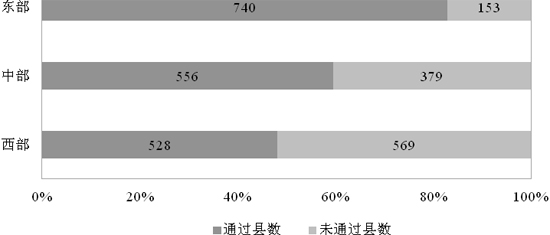
Figure 1 Number of counties identified by region
(three) for the 1301 that has passed the identificationoneA county for monitoring and review.
In order to consolidate the balanced development achievements of compulsory education and prevent the decline of the balanced level, according to the provisions of the Interim Measures, the balanced development of compulsory education in 1301 counties recognized by the state from 2013 to 2015 was monitored and reviewed for the third time. Based on the statistical data of national education, the development level of compulsory education in counties and the inter-school balance were tracked and evaluated with the eight indicators for calculating the difference coefficient specified in the Interim Measures as the focus. The monitoring results show that the balanced development level of compulsory education in 1301 counties has improved slightly on the whole. Compared with 2014, the comprehensive difference coefficient of primary schools in 2015 decreased from 0.420 to 0.407, and that of junior high schools decreased from 0.357 to 0.346 (see Figure 2). The average values of the eight indicators basically showed an increasing trend, among which the total value of teaching instruments and equipment per student increased the most, with the increase rates of 8.83% in primary school and 11.38% in junior high school respectively.
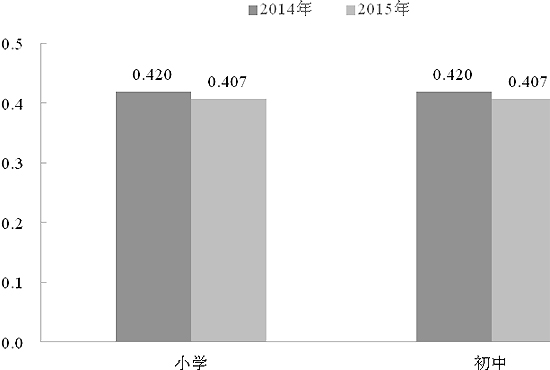
Figure 2 Comprehensive Difference Coefficient of Primary and Junior High Schools in 1301 Counties in 2014-2015
In 21 counties of 10 provinces, there is a big landslide, and the comprehensive difference coefficient of primary school or junior high school can not meet the standard requirements, and the comprehensive difference coefficient of primary school and junior high school in 3 counties is not up to standard. The Office of the State Council Education Steering Committee organized interviews with the government, education and supervision departments of 21 counties and their cities and provinces, and issued rectification notices to the general office of the provincial government to urge comprehensive rectification in place.
(four) the process of monitoring the counties that have not passed the identification.
In order to grasp the dynamic changes of the balanced development of compulsory education in counties that fail to meet the standards, based on the statistical data of national education in 2015, the balanced development of compulsory education in more than 1,200 counties that have not passed the national assessment was monitored in a process. On the whole, the balance level of unrecognized counties is obviously lower than the national standard, and even lower than the more than 1,800 counties that have been recognized, so it is difficult to achieve the goal of balanced development. Further analysis shows that 48.5% and 54.51% of counties in the central and western regions have not yet been identified, which will be difficult areas to tackle; Looking at the index of primary school difference coefficient alone, there are still 56.9% unidentified counties that can’t meet the requirements, and the proportion is high, which will still be a difficult section to attack.
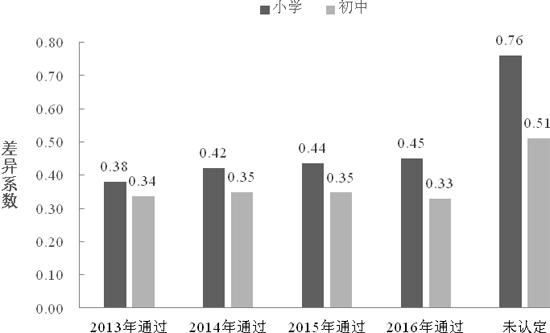
Fig. 3 Difference coefficient between recognized counties and unrecognized counties in each year
Second, the effect and experience of balanced development of compulsory education
Through supervision and evaluation, we urge local governments to constantly strengthen their sense of responsibility, make overall plans, increase funding, optimize the allocation of teachers, improve school conditions, improve the quality of education at the management level, care for special groups, and strive to improve the balanced development level of compulsory education. According to incomplete statistics, since the start of supervision and evaluation in 2013, all localities have invested a total of 2.73 trillion yuan to promote the balanced development of compulsory education, built about 200,000 schools, increased 20 million degrees, supplemented 1.3 million teachers, and participated in exchanges with 1.85 million principals and teachers, which has effectively promoted the balanced development of compulsory education.
(A) clear development strategy, the implementation of government responsibility
Governments at all levels have fully implemented the the State Council strategic plan of the CPC Central Committee, and given priority to the balanced development of compulsory education as the greatest livelihood.
First, innovate the working mechanism and further promote the balanced development of compulsory education. Guangdong Province has comprehensively established the "three overall plans" promotion mechanism of overall planning of work, overall planning of funds and overall planning of assessment, and implemented the government responsibility system of developing education and promoting the balanced development of compulsory education. Liaoning Province has included the balanced development of compulsory education in the performance evaluation indicators of municipal governments, improved the provincial supervision and evaluation methods, and simultaneously started the monitoring information system at the provincial, city, county and school levels for dynamic monitoring, so as to promote the establishment of a coordinated and efficient work promotion mechanism in various places. Gansu province has formed an effective working mechanism of "basic education promotion, supervision and evaluation, performance appraisal and combination of rewards and punishments". Heilongjiang Province has established a promotion system such as layout adjustment monitoring mechanism, work promotion network account system, completion task sales number system, special supervision system, supervision notification, reward and compensation mechanism. The leaders of the provincial government talked about the cities and the counties under inspection this year one by one, and urged the implementation of the task of balanced development. Yunnan Province has formulated a series of documents, such as the Implementation Plan of Poverty Exit Mechanism in Yunnan Province, which takes the balanced development assessment of compulsory education in counties as one of the five assessment indicators for poverty-stricken counties, and clearly puts forward the "synchronous planning, synchronous implementation and synchronous assessment" of balanced development of compulsory education and poverty alleviation. Shandong Province organically combines the balanced development of compulsory education with the comprehensive thinning and solving the problem of large class size. Focusing on the three key issues of land, teachers and funds, Shandong Province has issued clear preferential policies and arranged 2 billion awards and supplementary funds, and defined the work goal of basically solving the problem of large class size in urban ordinary primary and secondary schools by the end of 2017.
The second is to strengthen the leverage of supervision and provide long-term guarantee for the balanced development of compulsory education. In the balanced supervision of compulsory education, Xinjiang Uygur Autonomous Region adheres to "three rounds of supervision" (process supervision, pre-inspection, evaluation and acceptance) and "full coverage+repeated inspection" (the scope of supervision covers all schools, and the supervision of outstanding problems is strengthened) to accurately locate the problems. Hunan Province has carried out three rounds of "supervision, evaluation and assessment of the educational achievements of county-level governments and their leading party and government cadres", which regards the achievement of promoting the balanced development of compulsory education as an important content of the performance assessment of leading party and government cadres at county level. Jiangxi Province has established the mechanism of "Three Supervisors and Three Orders", issued the policy of awarding funds, cashed in 44 million award funds and arranged 1.5 billion special funds at one time. Hohhot, Inner Mongolia Autonomous Region, invested special funds to give 10-30 million awards to counties identified by national assessment. Yunnan Province has continuously improved the process supervision mechanism, strengthened problem orientation and promoted construction through evaluation, established an incentive and accountability mechanism for the balanced development of compulsory education, and awarded 10 million yuan to each county. Since 2013, Gansu Province has invested a total of 429 million yuan to reward 43 counties, and each county has awarded 10 million yuan. Since 2016, both Qinghai Province and Chongqing Municipality have given 5 million yuan in awards or awards to districts and counties that have completed the set goals of balanced development as scheduled. Hubei Province strengthened supervision and inspection, guided the promotion, and established an evaluation and commendation mechanism for demonstration counties with balanced development of compulsory education, and awarded 1 million yuan to 5 million yuan, which greatly mobilized the enthusiasm of all localities.
(2) Ensuring investment in education and implementing precise poverty alleviation.
Governments at all levels strive to implement the requirements of "three growth" and ensure the investment of compulsory education funds; At the same time, actively adapt to the general trend of new urbanization and household registration system reform and the integration of urban and rural compulsory education development, and gradually establish a unified funding guarantee mechanism for urban and rural compulsory education; Combined with the "all-round thinning" of funds, we will focus on rural and poverty-stricken areas and implement accurate poverty alleviation through education.
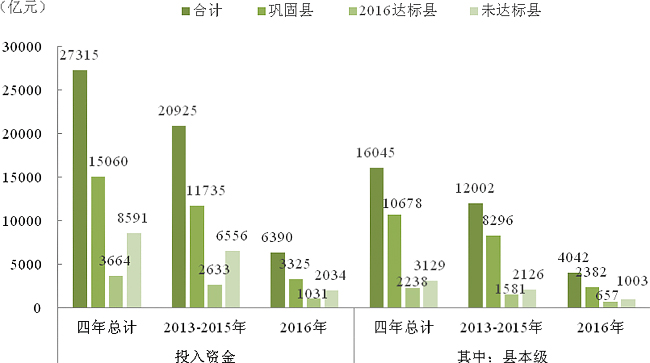
Figure 4 National compulsory education investment in recent four years (2013-2016)
According to incomplete statistics, 31 provinces (autonomous regions and municipalities) and Xinjiang Production and Construction Corps have invested a total of 2.73 trillion yuan in compulsory education since the supervision and evaluation of balanced development of county compulsory education was launched in 2013, including 2.09 trillion yuan in 2013-2015 and 640 billion yuan in 2016. In addition, the country’s total investment in the past four years was 1.6 trillion yuan at the county level, accounting for 58.7% of the total investment. Judging from the categories of counties, the consolidated counties that achieved a basic balance before 2016 have invested a total of 1.5 trillion yuan in the past four years. In 2016, the counties that reached the standard invested 370 billion yuan, and the counties that failed to meet the standard invested 860 billion yuan. County-level investment accounts for 70.9%, 61.1% and 36.4% of the total investment of the three types of counties respectively.
The first is to improve the funding guarantee system for compulsory education. In 2016, most provinces (autonomous regions and municipalities) issued implementation opinions on further improving the funding guarantee mechanism of urban and rural compulsory education, and some provinces (autonomous regions and municipalities) also issued implementation opinions on promoting the reform and development of urban and rural compulsory education integration within the county, providing financial guarantee and policy support for ensuring the equalization of basic public services and education equity, and establishing a balanced development mechanism of urban and rural compulsory education. Governments at all levels in Anhui Province have continuously improved the funding guarantee mechanism for compulsory education. In the past three years, the total amount of funding for compulsory education has been increasing at an annual rate of 8%.
The second is to implement the "comprehensive thinning" funds. Adhere to "supporting the weak and ensuring the bottom" and lean toward poor areas and weak schools. In 2012-2015, Guangdong Province invested 118 billion yuan in provincial education, focusing on increasing support for rural areas, poverty-stricken areas and weak links and key areas, with a total investment of 68.7 billion yuan in four years. In the past three years, Henan Province has invested a total of 14.09 billion yuan to co-ordinate the implementation of the "comprehensive thinning" project; Invested 62.69 billion yuan to implement the project of expanding urban compulsory education resources; Invest 7.5 billion yuan to implement the nutrition improvement plan for rural compulsory education students; Invested 17.99 billion yuan to implement the poverty alleviation project through education. In the past three years, Gansu Province has invested 14.46 billion yuan to co-ordinate the implementation of projects such as "comprehensive thinning"; Tianzhu County integrated funds of more than 4 million yuan to carry out heating projects for 43 boarding schools in high-altitude Tibetan areas, ending the history of heating schools with coal stoves. Sichuan Province has fully integrated compulsory education into the financial security system in accordance with the law and improved the special investment mechanism. As of June 2016, the total investment in "comprehensive thinning" funds was 12.6 billion yuan. Xinjiang Uygur Autonomous Region has established a policy-oriented mechanism that combines the allocation of project funds with the planning objectives three years ahead of schedule. By the end of August 2016, the autonomous region has implemented a total of 10.06 billion yuan in "comprehensive thinning".
(C) innovative management mechanism, urban and rural teachers together.
Governments at all levels constantly innovate the management, supplement, training and incentive mechanisms of teachers, and strive to create a team of teachers with excellent quality and dedication. Thirty-one provinces (autonomous regions and municipalities) and Xinjiang Production and Construction Corps have introduced measures for the implementation of the rural teacher support plan, focusing on rural and weak school teachers.
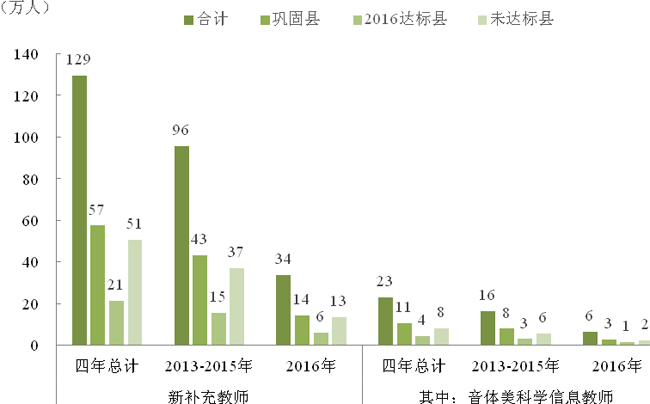
Figure 5 The situation of new supplementary teachers in compulsory education schools in China in recent four years (2013-2016)
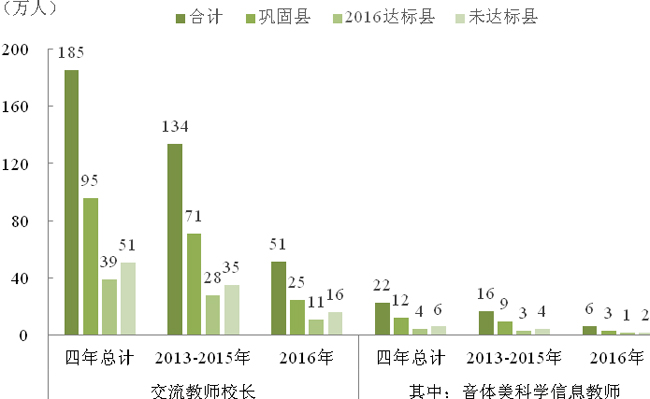
Figure 6 The situation of exchange teachers and principals in compulsory education schools in China in recent four years (2013-2016)
According to incomplete statistics, since the supervision and evaluation of the balanced development of county compulsory education was launched in 2013, there have been about 1.3 million new teachers in 31 provinces (autonomous regions and municipalities) and Xinjiang Production and Construction Corps, including 957,000 new teachers in 2013-2015 and 336,000 new teachers in 2016; In addition, among the newly added teachers in the past four years, there are 228,000 teachers of scientific information about music, sports and beauty, accounting for 17.6% of the total number of newly added teachers. Judging from the categories of counties, there were 574,000 new teachers in the consolidation counties that achieved basic balance before 2016, 213,900 in the counties that reached the standard in 2016, and 505,000 in the counties that failed to meet the standard. Teachers of scientific information in music, sports and beauty account for 18.5%, 19.6% and 15.8% of the total number of newly added teachers in the three counties respectively. In the past four years, there were 1,850,600 principals of exchange teachers nationwide, including 1,336,000 principals of exchange teachers in 2013-2015 and 515,000 principals of exchange teachers in 2016. In addition, among the principals of exchange teachers in the country in the past four years, there were 224,000 teachers of scientific information in music, sports and beauty, accounting for 12.1% of the total number of exchange teachers. Judging from the categories of counties, there were 955,000 teachers and principals in the consolidation counties that achieved basic balance before 2016. In 2016, there were 386,000 new exchanges in the counties that reached the standard, and 509,000 exchanges in the counties that failed to meet the standard. Teachers of scientific information in music, sports and beauty account for 12.6%, 11.6% and 11.5% of the total principals of exchange teachers in the three counties respectively.
The first is to innovate the establishment management mechanism and flexibly solve the problems of teacher recruitment and withdrawal. Fujian province takes the lead in implementing the unified teaching and administrative staff establishment standard in urban and rural areas, and approves the establishment of small-scale compulsory education schools in rural areas according to the combination of student-teacher ratio and class-teacher ratio; The management system of "county-oriented, county-managed" primary and secondary school teachers was established earlier in the country, and the "six unifications" in the salary, preparation standard, post structure ratio, recruitment and deployment, assessment and management service of public teachers in compulsory education were achieved in the county, which made teachers change from "school people" to "regional people" and laid a solid foundation for the balanced allocation of teachers in the county. In 2013, Qinghai Province unified the establishment standards of primary and secondary school teachers in urban and rural areas. The new establishment standards consist of three parts: basic establishment, additional establishment and special establishment. The newly established special establishment is inclined to agricultural and pastoral areas, bilingual teaching and teaching points. Shandong Province has made great efforts to strengthen the construction of teachers in rural primary and secondary schools. Within the total establishment of public institutions, it has established a special account for the temporary turnover of primary and secondary school teachers by streamlining and compressing the establishment and reforming public institutions. If it is really necessary to supplement full-time teachers in full-time and overstaffed primary and secondary schools, it will be supplemented by the preparation of temporary accounts. In recent three years, Ningxia Hui Autonomous Region has handled early retirement for 995 teachers who are not suitable for teaching, and recruited 580 special post teachers and 78 free normal students, effectively alleviating the unreasonable subject and age structure of rural primary and secondary school teachers.
The second is to innovate the supplementary mechanism of teachers and stabilize the teaching staff. Guangdong Province has taken the lead in implementing the policy of "Refund of fees for college graduates who teach in rural areas". The provincial finance has arranged special funds to refund 6,000 yuan per year for undergraduate and junior college graduates who teach in rural schools in eastern and western Guangdong, with four years for undergraduate and three years for junior college graduates. At present, the province has supplemented 42,000 qualified teachers for rural schools in underdeveloped areas; Among them, more than 20% are teachers in English, physical education, music, beauty and preschool education who are in short supply in rural schools. Hunan Province has implemented the public-funded directional training plan for rural primary school and kindergarten teachers, which has formed a multi-level, multi-school system and multi-category training pattern of "one goal", "two-level training", "three academic systems" and "four types of plans". In the past three years, 14 counties in Chenzhou City have supplemented more than 1,500 normal students trained at public expense to teach in rural schools. Guangxi Zhuang Autonomous Region has innovatively implemented the orientation training plan for normal students, enrolling new students from ordinary high schools and junior high schools, and supplementing the general training, free education and key orientation to village schools and teaching points. Since the "Twelfth Five-Year Plan" in Guizhou Province, a total of 53,000 special post teachers have been recruited, ranking first in the country for several consecutive years. The "Special Post Plan" covers 88 counties in the province. Sichuan province has focused on the implementation of the "special post teachers" and "free normal students" programs, which have been included in the provincial government’s livelihood projects, and have provided free directional transportation and supplementary teachers for 4000 teachers in 119 poor counties. Fujian Province has established a unified open recruitment system for new teachers in primary and secondary schools in the province, with an investment of 135 million yuan in the past five years.The "Compensatory Tuition Plan for Teachers in Rural Shortage Subjects" has invested more than 200 million yuan to carry out the "Subsidy Plan for Teachers in Rural Schools in Economically Difficult Counties" to implement "precise replenishment" for teachers in weak areas and weak disciplines. In the past five years, the province has supplemented 33,000 primary and secondary school teachers, 50% of whom are teachers in short supply subjects. More than 6,000 teachers have been added to poverty-stricken counties in 23 provinces in the past three years, of which 52% are teachers in subjects such as music, sports, beauty, science and information technology. The 12 counties inspected in Hubei Province have actively implemented the "new mechanism" for supplementing rural teachers deployed at the provincial level. In the past three years, more than 3,900 teachers with the "new mechanism" have been recruited, and all of them have been arranged to teach in remote and weak rural schools. Dehui city City, Jilin Province has fully implemented the special post plan, master teacher plan and free normal student plan. In 2013-2015, a total of 360 outstanding graduates from normal universities were hired, and 110 teachers were recruited for social recruitment, all of whom were assigned to teach in weak rural schools. In 2016, bohu county City, Xinjiang Uygur Autonomous Region invested 1.6 million yuan to recruit 25 supernumerary teachers with equal pay for equal work for the first time, effectively alleviating the structural shortage of teachers.
The third is to improve the training mechanism and improve the comprehensive quality of teachers. Eight provincial primary and secondary school teachers’ development centers were built in Guangdong Province, and nearly 5 million primary and secondary school teachers were trained in 2015, of which about 50% were trained at or above the county level. Duanzhou District of Zhaoqing City has invested more than 2 million yuan in continuing education every year. In the past three years, it has sent about 30,000 people to participate in training at all levels, and cooperated with universities to carry out teacher training for more than 640 people. Fujian Province invested 300 million yuan during the Twelfth Five-Year Plan period to complete the training of all rural principals and teachers; During the "Thirteenth Five-Year Plan" period, the rural principals’ assistance project and the rural teachers’ quality improvement project were launched, and it is planned to train 85,000 rural teachers and principals in the province, of which the provincial finance plans to invest 100 million yuan to train 4,000 rural principals and 10,000 rural teachers. Shanzhou District, Sanmenxia City, Henan Province, launched a "menu-based, order-based" training model based on teachers’ professional needs, and established 10 education and teaching practice bases to realize the "six combinations" of teacher training forms. Weiyuan County, Sichuan Province provides a "menu of famous teachers" through the network platform, allowing each teacher to choose their own teachers and improve the effectiveness of training. Tongshan County, Hubei Province, carried out "joint school walking teaching" and "joint school online teaching", which realized the interactive exchange between urban and rural teachers and the co-construction and sharing of high-quality resources. Shangrao County, Jiangxi Province actively promoted the localization training project of teachers, and through five years’ efforts, it trained a normal student for all 112 teaching points in the county.
The fourth is to improve the teacher exchange mechanism and promote the balance between urban and rural teachers. Yunhe District, Cangzhou City, Hebei Province has changed from "unit person" to "system person", and promoted the exchange of teachers between urban and rural areas through the construction of alliance schools. In the past three years, 36 principals and vice principals and 352 teachers have been exchanged respectively. Xiuwen county City, Guizhou Province, has improved the incentive mechanism for teachers’ exchange, and adopted the measures of 5,000 yuan for each teacher exchanged in the county to promote the balance of teachers. In recent three years, Ruichang City, Jiangxi Province has recruited 788 teachers, accounting for 25.3% of the total number of teachers in the city, and 727 exchange rotation teachers, accounting for 14.4% of the total number of teachers in the city. Hunan Province has listed "rotation exchange between principals and teachers of compulsory education schools" as a key reform project in the province. In the past two years, 10 million yuan of provincial-level special award funds have been awarded to 14 pilot counties, and a total of 553 school-level leaders participated in the rotation and 4670 teachers exchanged ideas. Tongliang District of Chongqing has carried out the exchange of cadres and teachers through regular exchanges, regional rotation, hanging up and dispatching down, with the proportions reaching 16.03% and 10.3% respectively.
The fifth is to explore innovative incentive mechanisms to increase the attractiveness of rural teachers. First of all, institutionalized rural teacher subsidies have become the norm. Guangdong Province has fully implemented the post allowance policy for rural teachers throughout the province since 2013, and raised the standard to not less than 800 yuan/month in 2016; In 2015, 330,000 rural teachers in the province enjoyed the monthly living allowance in 730 yuan, and the average salary of rural teachers was 15% higher than that of local urban teachers. In some areas, urban school teachers volunteered to teach in rural schools. In the past three years, Qianshan County, Anhui Province has implemented nearly 40 million yuan of subsidies for rural teachers, rural hardship schools and township work. The monthly subsidy for teachers in remote rural areas of Jinzhai County and Taihe County is as high as 1,500 yuan and 1,300 yuan. Secondly, improve living conditions and warm teachers. Kunming City, Yunnan Province, implements the living allowance for rural teachers in the whole city, and gives the living allowance according to the standard of 500-1500 yuan per person per month, plus the ethnic and bilingual adjustment coefficient, up to 1950 yuan. Bianba County, Xizang Autonomous Region, purchased 5,000 yuan of daily necessities for all teaching point teachers, and realized "carrying a bag to stay". Qijiang District, Chongqing Municipality set up a fund to help rural teachers with major diseases, and built a turnover room for teachers of 20,000 square meters. Fan County, Henan Province organizes a free physical examination for teachers in the county every two years. Third, take incentive measures to attract outstanding talents. The two counties (districts) inspected in Ningxia Hui Autonomous Region have formulated detailed rules for the implementation of the rural teacher support plan.355 rural teachers who have worked continuously in the countryside for 25 years have been promoted to deputy senior titles. Since 2012, Puxian County, Shanxi Province has invested more than 3.6 million yuan in subsidies for rural teachers and class teachers, and 1 million yuan in rewards for principals and teachers. The principal of rural school in Tianyang County, Guangxi Zhuang Autonomous Region can get an incentive performance salary of up to 4,000 yuan per person per year.
(D) efforts to overcome difficulties and improve school conditions.
Governments at all levels take "all-round thinning", standardized school construction and information construction as the starting point, fill in the shortcomings, raise the bottom, make up what is missing and how much is missing, vigorously improve the conditions for running compulsory education schools, and improve the balanced level of inter-school and urban-rural resource allocation.
Table 2 Improvement of hardware resources for running schools in recent four years (2013-2016)
According to incomplete statistics, since the supervision and evaluation of balanced development of county compulsory education was launched in 2013, 31 provinces (autonomous regions and municipalities) and Xinjiang Production and Construction Corps have built 12,000 new schools, renovated and expanded 191,000 schools, added nearly 20 million degrees, added 340 million square meters of school buildings, added 6.97 million laboratories and function rooms, added 283.9 billion yuan of teaching instruments and equipment, and added 11 books.
The first is to strengthen the standardization of schools. All localities have comprehensively promoted the standardization construction of compulsory education schools, coordinated the implementation of major engineering projects, and implemented the objectives and tasks of the school standardization process in schools every year, and the school’s compliance rate has been continuously improved. At present, the proportion of qualified schools in Sichuan Province has reached 76.5%, and the standardization rate of primary and secondary schools in Anhui Province has reached 96%. Through the poverty alleviation project in mountainous areas, counties in Shijiazhuang City, Hebei Province have transferred more than 15,000 students from mountainous areas to a number of newly-built standardized schools in plain areas. Xilinhot City, Inner Mongolia Autonomous Region has invested a total of 1.8 billion yuan to build, relocate, rebuild and expand all primary and secondary schools in the city, achieving "full coverage" of gymnasiums, plastic playgrounds, recording and broadcasting rooms and electronic large screens. Some provinces have extended the construction of standardized schools to teaching points. Fujian Province has formulated "Standards for Basic Conditions for Running Schools for Teaching Points". In remote areas with inconvenient transportation and difficult conditions, 2,529 rural teaching points are reserved, and all localities are urged to strengthen the funding guarantee, facilities and teachers’ equipment, so as to ensure that the teaching points are basically in full swing. Xiamen and zhangping city have accepted standardized schools for teaching points, and the construction level of teaching points has been greatly improved. Hunan Province has included the construction of standardized teaching points in the key livelihood projects of the provincial government. As an important part of the performance appraisal of governments at all levels, the province has completed the construction of more than 2,400 standardized teaching points.
Second, attach great importance to the construction of school informatization. Combined with the construction of "experimental province of educational informatization" and the only "experimental area of comprehensive reform of educational equipment" in Hainan Province, more than 80% of the classes in the province use digital resources for teaching, and more than 90% of teachers and more than 50% of junior high school students have real-name online learning space. Wuzhishan City has equipped computers for each teaching point and opened a 2-megabit optical fiber network to achieve full coverage of digital education resources at teaching points. In 20 counties in Shaanxi Province this year, there is one computer for teachers’ office, and the multimedia facilities for ordinary classrooms, electronic whiteboards or touch-control integrated machines have basically achieved full coverage. Schools with a scale of more than 1,000 people have built campus TV stations or recording and broadcasting rooms. Fujian Province has connected 20M broadband to 4,683 rural primary and secondary schools above primary school, and paid the broadband usage fee for five years. Linzhou County, Xizang Autonomous Region has realized the digitalization of digital resources in the county, and all classrooms can be taught remotely through the monitoring system. Jiangjin district invested 140 million yuan to build "six function rooms" such as sound, body and beauty, and to purchase information equipment, thus realizing the "reinvention" of educational equipment.
(5) Deepening education reform and improving the quality of education.
Governments at all levels firmly establish the "people-oriented" educational thought, carry out quality education in depth, adhere to running schools with characteristics, improve school management, cultivate campus culture, deepen teaching reform, strive to create campus culture with characteristics, promote students’ healthy growth and all-round development, and continuously improve the quality of education.
The first is to explore the reform of the alliance school-running system. Guangdong Province implements the supply-side reform of educational resources, and adopts diversified school-running systems such as merger, trusteeship, one school with multiple districts, group school-running and the establishment of school alliances, so as to promote famous schools to export high-quality educational resources and advanced school-running concepts and promote the common development of other relatively weak schools. Liubei district, Chengzhong District and Jinchengjiang District of Liuzhou City, Guangxi Province have formulated unified requirements to promote group-based school running, and set up education groups through "close", "alliance" and "cooperation" to promote the sharing of quality education resources. Ganzhou District, Zhangye City, Gansu Province, set up 14 urban and rural schools to develop a consortium and implement regional "integrated running schools"; Lintao county explores the integrated management of rural central schools and teaching points to ensure that small-scale schools offer courses. The new urban area of Urumqi, Xinjiang is classified and zoned to establish a "three-zone integration" management mechanism of university area, inspector responsibility area and teaching and research cooperation area. Weishan County, Shandong Province, builds an educational development community of "hosting schools, school alliances and interaction between urban and rural areas" to promote the synchronous and high-quality development of urban and rural areas. Yangqu County, Shanxi Province has adopted various modes such as "education alliance, school district management and counterpart assistance" to form a teaching cooperation community of "county linkage, urban-rural integration and shared development". In Wanzhou District, Chongqing, 66 villages complete primary schools and central schools to form an integrated school district, and implement "five unifications" in administrative work and funding arrangements; Qianjiang District has set up "1+N" eight collectivized school-running modes, set up the teaching and research section of the group center, implemented bundled assessment, and taught in schools through mobile workstations, backbone teachers, and cross-school teachers in short supply.Balanced allocation of teachers. Luanping County, yutian county County, Changli County and Haigang District of Qinhuangdao City in Hebei Province seized the opportunity of Beijing-Tianjin-Hebei integration and formed alliances with famous schools in Beijing and Tianjin to help improve the overall level of local education.
The second is to deepen the reform of curriculum teaching. Since 2013, Guangdong Province has allocated a special fund of 20 million yuan every year for three consecutive years to explore the construction of a textbook system for compulsory education with its own characteristics, and continuously strengthen the curriculum reform of basic education and the construction of local curriculum systems in primary and secondary schools. Wafangdian city City, Liaoning Province pays attention to the development of school connotation, actively promotes curriculum reform, carries out primary school curriculum integration experiments, and explores the "8+1+X" curriculum model. Longshan District, Liaoyuan City, Jilin Province has promoted the classroom teaching reform as a whole, built three curriculum reform models, such as "student-based classroom", "life subject" and "efficient classroom", and developed four characteristic courses and more than 20 school-based courses to promote the teaching quality. Fujian Province has carried out in-depth curriculum reform, selected a number of experimental units for comprehensive teaching reform and 100 schools for teaching and research bases, which have been popularized and developed in a rolling way, and emerged some typical teaching reform models such as "school-based homework" in Xiamen and "effective teaching by layers and steps" in Quanzhou, and built a classroom teaching model with "light burden and high quality". Taierzhuang District, Zaozhuang City, Shandong Province insisted on promoting the teaching method of educator Cai Linsen’s "learning first, teaching later and training in class" for 10 years, and constructed the "three-six-five-year eco-efficient classroom" model.
The third is to adhere to characteristic development and connotation development. In Feixiang District, Handan City, Hebei Province, school moral education has been strengthened, and Lei Feng Exhibition Hall and Times Model Hall have accepted more than 100,000 students to visit and study. The district has also established an all-round development quality concept, which permeates classroom teaching, school management, teacher-student evaluation, extracurricular activities and so on. Suifenhe city, Heilongjiang Province, combined with regional characteristics, has cultivated five characteristics: red education, Russian teaching, port culture, national defense education and ice and snow culture. There are 80 work-study bases in primary and secondary schools in Zhanyi District, Qujing City, Yunnan Province, covering 80%. Through the construction of work-study base in Huaping County, 70% boarding schools have achieved self-sufficiency in meat and vegetables. Kangma County, Xizang Autonomous Region regards Nanni’s "fruit harmony" and Gala’s "harmony celebration" as the theme of the "three advances" activities of national traditional culture in the county. Erlianhaote, Inner Mongolia Autonomous Region, took advantage of the port to carry out foreign cooperation and exchanges with Mongolia, successively trained 1,500 international students, and held the exchange activities of the "Great Tea Road" China-Mongolia-Russia Youth International Summer Camp.
(6) Pay attention to special groups and implement shared development.
In the process of promoting the balanced development of compulsory education, all localities adhere to the principle that people share the fruits of educational development, actively implement inclusive policies, pay attention to the needs of special groups, and provide them with equal educational opportunities.
The first is to further solve the problem of children of migrant workers going to school for further study. Fujian Province implements the same policy for the children who move with them in the compulsory education stage. The children who move with them implement the enrollment policy of combining parents’ independent registration and computer allocation to ensure fair admission, and have opened the channels for senior high school entrance examination and college entrance examination. Although the total number of migrant children has doubled in the past decade, the proportion of migrant children attending public schools has always remained at around 90%. Guangdong Province has promulgated and implemented the measures for the implementation of the college entrance examination for migrant children, and 21 cities have introduced the plan for the entrance examination in different places. The province’s high school education has enrolled a total of 106,000 migrant children, including 42,000 from other provinces. The government actively undertakes the management responsibility for the enrollment of migrant children, and 100% of eligible migrant children are enrolled in public schools.
Second, care for left-behind children in rural areas in various forms. The Education Department of Guizhou Province issued the "Guizhou Province Education Precise Care Plan for Left-behind Children (2015-2020)", which accurately cares for left-behind children through the implementation of a happy campus, a safe campus, self-confidence, twinning assistance, a family bridge, and full-time funding for the "six major projects". Hainan Province has built 154 "mobile bookstores for left-behind children in rural areas" at the provincial, city and county levels, so that left-behind children can enjoy learning. Lingbi County, Anhui Province invested 540 million yuan to build 47 public boarding schools and create 125 "care homes for left-behind children", which fully cared for more than 40,000 left-behind children. Menyuan County, Qinghai Province actively contacted non-governmental student organizations to carry out the "Flower Protection Action", raising 3.06 million yuan to help 8133 left-behind children.
The third is to strengthen the security of special education. For three consecutive years, the Fujian Provincial Party Committee and the provincial government listed the "Special Education Promotion Project" as a private practical project, with a provincial investment of 113 million yuan to complete 48 special education school building projects, with an additional school building area of 155,000 square meters. Counties with a population of more than 300,000 in the province have achieved full coverage of special education schools. 76 counties have launched a pilot program of "sending children with severe disabilities to their homes", providing home education for 1,195 children with severe disabilities. Several inspected counties in Tangshan City, Hebei Province have formed a pattern of special education combining rehabilitation, education, skills training and employment, and students have won many awards in national and provincial competitions. Zhuxi County, Hubei Province has included all disabled children in the minimum living allowance category, and the enrollment rate of three types of disabled children in the county has increased year by year. Chengdong District, Xining City, Qinghai Province has fully implemented 15-year free education for disabled children.
Fourth, the level of institutionalization and subsidy standards for poor students have been continuously improved. Fujian Province has set up a subsidy standard for students who care for poor families, and the standard subsidy for living expenses is 1,250 yuan per year for primary school students and junior high school students in 1000 yuan. Wuzhishan City, Hainan Province has raised the subsidy standard for students from poor families who set up a card, with an annual subsidy of 4,200 yuan for primary school students and 5,000 yuan for junior high school students. In 2014-2015, since 2015, Renbu County of Xizang Autonomous Region has used 1% of the fiscal revenue of the previous year as a student aid fund, Bango County has implemented an orphan aid fund of 114,600 yuan, and Gaer County has set up an education incentive fund of 300,000 yuan every year to help poor students enter school. Yuanzhou District, Guyuan City, Ningxia Hui Autonomous Region, actively implements the nutrition improvement plan for rural students, and implements more than 30 million yuan every year. By grasping the "four systems", strictly controlling the "six passes" and building "four account books", 50,000 rural primary and secondary school students can enjoy healthy nutritious meals, which has become a model of the nutrition improvement plan "Ningxia Model". Yanbian Prefecture of Jilin Province implements the policy of "three exemptions and one mention" for the public funds of Korean education.
Third, the main problems in the balanced development of compulsory education
(A) the funding guarantee mechanism for compulsory education is still not fully implemented.
In 2016, 522 counties in 26 provinces (autonomous regions and municipalities) participated in the supervision, evaluation and identification of the balanced development of national compulsory education, among which 8 provinces (autonomous regions) did not put in place the funding guarantee mechanism for compulsory education, mainly in the following aspects: First, the education funding policy was not put in place, and the funding gap of individual schools in some counties was large; Second, the three statutory increases in compulsory education funds have not been realized. In recent three years, individual counties have failed to fully realize the "three growth" requirements of compulsory education funds, and lack a long-term mechanism to ensure the steady growth of education funds.
(B) there are still weak links in the basic conditions for running a school.
Due to the peak of population growth, the rapid growth of population gathering in some areas and other factors, especially the shortage of educational resources in the main city, there are excessive class sizes to varying degrees; The school area and school building area are insufficient, and the area of sports venues per student is insufficient in the main city. Some schools have insufficient functional (special) classrooms. In some schools, the average value of teaching instruments and equipment is low, and the teaching AIDS and equipment such as books, computers and experimental supplies are outdated and under-equipped. The construction of campus network and multimedia classrooms in some rural areas and ethnic minority areas lags behind.
(C) the construction of teachers needs to be further strengthened.
The shortage of full-time teachers in some provinces and ethnic minority areas in the central and western regions is serious, and it is difficult to implement the policy of allocating teachers according to the ratio of classes to teachers in small rural schools. Some rural teachers are aging, their age structure is unreasonable, and the proportion of young teachers is low; The structural gap of teachers’ disciplines still exists to varying degrees. A considerable proportion of provincial schools, especially those specialized in music, sports, beauty, foreign languages, science and information, have a serious gap. In some areas, the exchange mechanism and incentive mechanism between principals and teachers are lagging behind, and the school-running concept and management level of some school principals need to be further improved; Rural teachers have few opportunities to study abroad, the proportion is low, the funds for teacher training are insufficient, and the professional promotion of teachers is weak; The policies on the evaluation and employment of teachers’ professional titles, preparation and welfare benefits have not been fully implemented.
(D) The school management level and the utilization rate of educational resources need to be improved.
Some local education administrators are not familiar with national policies and have a weak awareness of information disclosure, so they can’t effectively use schools to publicize the tilted investment made by the state to promote the fair development of compulsory education. The modern school system is not perfect, the management mode of education and teaching lags behind, and the daily management level needs to be improved urgently. The consciousness of curriculum reform is weak, the teaching methods and means of teachers’ education are single, and the implementation of experimental courses, comprehensive practice and labor education is not in place; The school has been equipped with teaching equipment, books, etc., and the utilization rate of students is low. The utilization rate of information resources is not high, and information means can not serve school management and education and teaching reform well. The campus culture of some schools is not strong enough, and the characteristics of running schools are not clear enough.
(E) Education and security mechanisms for students with special needs need to be improved.
In some areas, the problem of rural junior high school students dropping out of school has not been completely solved, and the drop-out rate of individual school students has risen. Some local governments have insufficient measures to care for left-behind children and migrant children of migrant workers, and the construction of rural children’s palaces is far from meeting the needs. The educational opportunities for students of special groups have not been fully guaranteed. Some boarding logistics personnel and health personnel are lacking, security work is not in place, sanitary management of school canteens is not standardized, there are potential safety hazards, and the renovation of dry toilets in rural and remote areas is lagging behind. It is difficult for some remote small-scale schools to implement the nutrition improvement plan, such as the high cost of feeding in enterprises and canteens, and the difficulty in obtaining health permits for meals in small rooms.
Iv. Suggestions on accelerating the balanced development of compulsory education
(A) to ensure the statutory growth of funds and broaden the channels of resource supply.
First, implement policies and regulations to ensure the "three growth" of compulsory education funds. During the supervision and inspection, it was found that some counties under inspection failed to fully realize the "three growth" in recent years. Through the supervision and inspection, although they have been basically supplemented, they still lack a long-term guarantee mechanism for compulsory education funds. Governments at all levels should, in accordance with the requirements of national laws and regulations, further improve the guarantee mechanism of compulsory education funds, strengthen the supply of main financial channels, and strengthen the management of budget preparation to ensure the statutory "three growth" of compulsory education funds. We will intensify the additional collection of education, implement the policy of allocating education funds in proportion to the income from land transfer fees, and ensure that they are allocated in time and fully used for education. Provincial finance and education supervision departments should establish an inspection and supervision mechanism for the education investment of governments at all levels, and take the education investment as an important assessment content for the main leaders of the government.
The second is to constantly innovate the way of public service supply and broaden the channels of resource supply. With the goal of narrowing the gap in inter-school resource allocation, we will further carry out the reform of school-running system, such as school alliance, group-based school-running, school district-based management, and counterpart assistance, establish an alliance-based school-running model with strong strengths and weak strengths, implement community-bound development, and promote the co-construction, sharing and integrated development of regional schools. In areas with low level of economic development that have not been recognized by basically balanced counties, it is necessary to strengthen the supplementary channels of resources and open up new sources, implement the government’s purchase of private school degrees, logistics services, contract teaching staff, high-quality training institutions’ teaching resources, encourage private investment, and implement diversified school-running system reform to solve the problems of insufficient degrees, limited establishment and lack of high-quality resources.
Third, based on the principle of fair development, continuously improve the efficiency of the use of funds. To explore the new mechanism of education fund management, it is necessary to reflect "giving charcoal in the snow", focus on rural areas and weak links, and make overall plans to solve development problems. It is necessary to effectively improve the efficiency of the use of educational resources and avoid the phenomenon of "idle while building".
(B) unified school construction standards, the implementation of urban and rural development.
First, intensify standardization construction. It is necessary to take the standardization construction of compulsory education schools as the starting point, combine the "overall thinning" plan, speed up the improvement of the conditions for running schools that fail to meet the standards, and strictly follow the requirements of provincial construction standards in terms of school infrastructure, teaching facilities, living facilities, sports facilities and modern information technology facilities, and build one school into one, and change one school into one, so as to ensure that every index of every school in urban and rural areas meets the provincial standards for running schools.
The second is to scientifically plan the school layout. We should pay attention to the impact of population changes caused by the development of urban-rural integration and new urbanization on compulsory education, conscientiously do a new round of urban-rural planning, plan and reserve enough land for compulsory education schools, and build a mechanism for the layout and construction of urban-rural compulsory education that is compatible with the urbanization process and the growth trend and spatial layout of permanent residents. On the basis of scientific demonstration and meeting the needs of nearby enrollment, we should conscientiously adjust the school layout.
The third is to solve the problem of "large class size" in urban areas and "hollow schools" in rural areas simultaneously. It is necessary to constantly improve the monitoring mechanism of engineering projects and focus on solving the problems of large class size, insufficient area and insufficient degree in urban schools. It is necessary to improve the quality of education and teaching in rural schools and reduce educational immigrants. It is also necessary to run small-scale schools such as teaching points that need to be preserved and improve the standardization level of their educational resource allocation.
(C) accurate complement of teachers, pay attention to school management improvement.
We should always focus on the improvement of the ability level of principals and teachers and the balanced allocation of teachers. Principals and teachers are the productive forces that make the hardware conditions for running schools work, and they are the core elements to narrow the inter-school differences in education quality.
First, straighten out the management system of principals and teachers. Continue to implement the principal rank system, and expand the county-level education administrative departments’ authority to appoint, remove and transfer principals. Implement the functions of county-level education administrative departments in charge of primary and secondary school teachers’ qualification identification, recruitment, job evaluation, training, deployment and exchange, file management, assessment, rewards and punishments. To do a good job in the rational formulation and dynamic adjustment of teachers’ staffing in compulsory education schools, small-scale schools and teaching points should be equipped with teachers’ staffing according to the class-teacher ratio in accordance with the relevant requirements of the state to meet the needs of education and teaching.
The second is to accurately supplement teachers. We will continue to implement the rural teacher support program, the special post teacher program, the system of training normal students at public expense, and the teacher exchange system, and encourage, attract and arrange outstanding graduates, backbone teachers, and teachers in short supply disciplines to teach in rural schools, with special emphasis on strengthening the construction and supplement of teachers in disciplines such as music, physical education, beauty, computer, English, and comprehensive practical activities, so as to ensure that rural schools can start full courses prescribed by the state.
The third is to comprehensively improve the professional level of principals and teachers. Take various measures to broaden the training of rural teachers, especially those in remote schools, and comprehensively improve the quality of rural teachers. Establish a support service system for rural teachers’ professional development and improve the professional level of principals and teachers as a whole. Cultivate famous principals and backbone teachers in rural schools, and build a reasonable management and teaching echelon. It is necessary to further strengthen the construction of special-grade teacher workshops, local special-grade teacher studios and other groups, and give play to the radiation and leading role of famous teachers.
Fourth, always adhere to the principle of paying equal attention to hardware and software, and attach importance to the improvement of school management level. The level of school management determines the efficiency of the use of education funds and the development level of school connotation, which is directly related to the quality of running a school. Give full play to the role of listed inspectors, guide schools, especially rural schools, to fully implement the management standards of compulsory education schools, establish advanced school governance concepts, establish and improve various management systems and improve working mechanisms on the basis of strengthening the routine management of schools. Principals and teachers should standardize their own management, education and teaching behaviors according to the requirements of the standards and implement the requirements of the standards.
(4) Pay equal attention to promoting consolidation and upgrading, and comprehensively improve the level of balance.
At present, the balanced development level of compulsory education in all districts and counties in China has formed three groups, and different requirements should be adopted for the three types of areas.
First, for areas that fail to meet the standards, it is necessary to increase overall planning and strengthen target responsibility. According to the requirements of the memorandum and the provincial government’s planning objectives, we will further strengthen overall management, speed up the work progress, and ensure the balanced development of compulsory education as scheduled. Establish and improve the balanced development promotion mechanism of compulsory education with strong promotion, in-place inspection, strict assessment, clear rewards and punishments, and open accountability, strengthen supervision and inspection, guide the work of finding and filling gaps, and promote the balanced development goal to be realized as scheduled.
Second, for newly recognized counties, it is necessary to improve the long-term mechanism of balanced development of compulsory education and consolidate the results of balanced evaluation. Governments at all levels should realize the long-term and dynamic nature of promoting the balanced development of compulsory education, do a good job in dynamic monitoring of counties that have achieved the basic balanced goal, and establish and improve the monitoring and review system. County-level governments should formulate specific rectification plans in view of the existing problems and weak links, consolidate the achievements, and constantly improve the overall level of balanced development.
Third, areas with a high level of basic balanced development should take the lead in advancing from basic balance to high-quality balance. On the one hand, increase the overall management at the municipal level, promote the balanced allocation of regional urban and rural and inter-school education and teaching resources, and realize the integration of urban and rural public services; On the other hand, we should achieve balanced development among schools in the region on more indicators, especially on indicators that people care about and are closely related to the quality of education.
Note: 1. As there are two recognized districts merged in Jiangsu Province, the object of this review is actually 1301 counties.