"Old House" Becomes "New House" More than 600 households in Chongqing have a group dinner together.

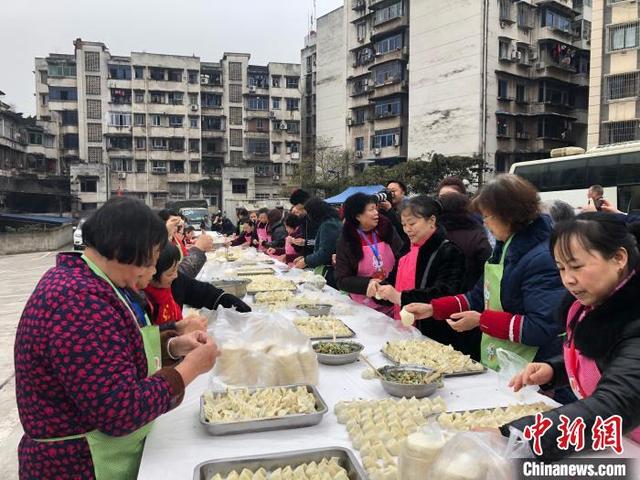
The picture shows the community residents getting together to pack jiaozi. Photo by zhōng·yǐ
(Going to the Grassroots in the Spring Festival) "Old Houses" Become "New Houses" More than 600 households in Chongqing have a reunion dinner together.
Zhongxin. com, Chongqing, January 16 th Title: "Old House" has changed into "New House". More than 600 households in Chongqing have a group dinner together.
Zhongxin. com reporter zhōng·yǐ
Bao jiaozi, writing Spring Festival couplets, painting sugar people … On the 16th, in Xingjiaqiao Community, Renhe Street, Liangjiang New District, Chongqing, there was a surge of "flavor of the year" everywhere. More than 600 households in the community gathered together to share the reunion dinner, raise a glass to celebrate the change of hundreds of households’ "old houses" into "new houses", and "happily move to new homes and celebrate the New Year" to wish a better life in the future.
The picture shows the activities of writing Spring Festival couplets in the community. Photo by zhōng·yǐ
The resettlement houses in Xingjiaqiao community have just undergone a comprehensive renovation project that lasted for nearly a year, which has improved the problems of old houses, old hospitals, old houses, old facilities and poor living environment in this area. At the beginning of 2020, the comprehensive renovation of 488 residential houses in the community was gradually completed, and residents moved back to their new homes one after another.
The picture shows more than 600 households in the community gathered together to share the reunion dinner. Photo by Zhong Xin
Through the photo exhibition, video materials and lively reunion dinner set up on the spot, the reporter felt the great changes in the lives of the residents in the area and their joy on their faces.
Xingjiaqiao Community is one of the earliest development and construction areas in the whole Liangjiang New Area. The community resettlement house was built in 1992, and it is a multi-storey brick-concrete structure commercial and residential building. Due to the early development and construction, it is obviously difficult to compare the planning layout, housing standards and materials used in the resettlement housing area with those in the modern community. In addition, after more than 20 years of baptism, the area has changed from a "new village" that everyone yearns for to an old old street.
The picture shows more than 600 households in the community gathered together to share the reunion dinner. Photo by Zhong Xin
"There are poor supporting facilities, poor security, poor municipal foundation, poor sanitary environment and poor living conditions. The poor living environment makes residents strongly hope to change the status quo." Xie Lan, secretary of the Party Committee of Xingjiaqiao Community, who has been rooted in the community for 17 years, said that 465 of the 488 houses leaked to varying degrees, and the walls and roofs of the living room and bedroom fell off; Cover the bed with film to keep out dust during the day, and lift it at night to sleep. From time to time, large pieces of dust and sand fall off the roof, which makes you sleepy. Cooking and cooking in the kitchen often leaves dust, adding some "seasoning" to the dishes; Don’t even dare to go to the toilet for a while, or you’ll have to take an umbrella and wear a straw hat. These are the true portrayal of residents’ life before the renovation of old houses.
All this is due to a policy that ushered in a "turning point"-in 2017, the Chongqing Municipal Party Committee and the Municipal Government included the renovation and upgrading of old residential areas in the urban upgrading action plan, and Xingjiaqiao community was included in the comprehensive renovation scope, involving 488 sets of resettlement houses, 91 facades and 1,422 people. The Management Committee of the Party Working Committee of Liangjiang New Area decided to renovate the area with the concept of urban repair and ecological restoration and the principles of safety, functionality, practicality, appreciation and economy.
At the end of 2018, the pilot building of Xingjiaqiao Community Comprehensive Improvement Project started. In March 2019, the comprehensive improvement project was officially launched.
It is worth mentioning that in the process of promoting the renovation of Xingjiaqiao’s old house, Xie Lan and his team worked with the spirit of "5+2" and "white+black", and reversed the residents’ attitude by organizing residents’ meetings, visiting door to door, customizing the plan for one household and decorating the model room. After being diagnosed with lung cancer, Xie Lan insisted on working despite illness, and won with tenacity, ingenuity, strength and enthusiasm.
On January 13th, 2020, Ms. Luo, the last resident who signed the resettlement house renovation project in Xingjiaqiao Community, Renhe Street, Liangjiang New District, came to the community office to sign the consent form for the renovation. It marks that the consent rate of Xingjiaqiao community home improvement project has reached 100%.
According to reports, the renovated Xingjiaqiao community will enjoy a five-story community service center, add about 800 parking spaces and build a new community park of 4,000 square meters to provide residents with a safe, convenient, comfortable and livable living environment.
Braised pork with plum vegetables, round brown sugar dumplings symbolizing family reunion, and roast duck with special characteristics indicating the future prosperity … At the scene, residents of Xingjiaqiao community sat together, sipping delicious dishes and toasting each other, and the laughter and blessings merged together, and the delicious dishes conveyed friendship and were filled with happiness and warmth.
"The renovation has not been completed yet, and we can’t relax. We will start a new task tomorrow. I want to thank the residents for their trust and support. In the future, I will, as always, stick to my original heart and always stand with the residents to contribute my modest strength to the bright future of Xingjiaqiao. " Xie Lan said.
Reporting/feedback

The Battle of Axle and Bridge: A War of annihilation with a tiger’s jaws pulled out.

Introduction to combat

The Battle of Axle was an offensive campaign against the Japanese Puppet Army in the southeast Axle area of Huai ‘an County, Jiangsu Province, during the period of War of Resistance against Japan. The campaign began on March 5, 1944 and ended on March 6, 1944. After three stages, namely, the attack on the bridge, the aid from Lujiatan and the strategic shift, a total of 465 Japanese captains (including 24 prisoners) and 483 puppet troops (including 168 prisoners) were wiped out, and 53 bunkers were destroyed, which "created a new record of Japanese invaders captured alive in Central China". The victory of this campaign has disrupted the plan of "expanding the countryside" and "strengthening the reclamation" of the Japanese and puppet troops, made the central Jiangsu region a relatively stable rear base, and created good conditions for our troops to train and prepare for the strategic counterattack. The victory of this campaign also opened up the strategic links between the Soviet Union and the northern Jiangsu, Huainan and Huaibei regions, realized the fundamental improvement of the Sino-Japanese war situation, and became a symbol of the strategic counterattack in the battlefield behind the enemy lines in the Soviet Union.

Talk about criticism

In the Battle of Axle and Bridge, the New Fourth Army concentrated more than five regiments, combined guerrilla warfare with mobile warfare, and carried out siege and aid operations against important fortified positions of the Japanese army, creating an example of annihilation war in Central China of the New Fourth Army. Learn from the past and know the present. It is of great practical significance to comprehensively and objectively analyze the winning mechanism of the vehicle-bridge campaign and fully absorb its essence nutrients, so as to improve the efficiency of studying war cases, truly learn from history and strengthen the preparation for military struggle.

Campaign planning should focus on the overall situation and grasp the joints. The great victory of the vehicle-bridge campaign was first benefited from the overall situation and grasping the joints when planning the campaign. The 1st Division and the Suzhong Military Region accurately located the attack direction in the eastern part of Huaibao, which was based on the actual situation in Central China and the overall consideration made according to the overall strategic situation in Central China. First, the area is located at the junction of the two Japanese divisions. If it is attacked, the main force of the Japanese 65th Division, which is in charge of the defense in this area, is far away from Xuzhou, so it is difficult to reinforce in time. The possibility of the neighboring 64th Division’s aid is extremely low, which is convenient for a quick decision. Second, the 7 th Brigade of the 3 rd Division of the New Fourth Army is located in the east of the Huaihe River, ensuring the safety behind the north side of the 1 ST Division. In fact, in the Battle of Axle, the 7th Brigade captured the Zhuweizi stronghold between Lianshui and Axle, and effectively cooperated with the Battle of Axle. Third, this area is the connecting part of Jiangsu, North Jiangsu, Huainan and Huaibei. Controlling this area is conducive to communicating the strategic links between the four areas and implementing strategic maneuvers.

In order to open up the situation in the eastern part of Huaibao, we must capture the axle. Capturing Jingkou or Axle is the key point for the leaders of the 1st Division to consider. Finally, the determination to capture the vehicle bridge is mainly due to the following reasons: First, the vehicle bridge is the enemy command center in this area, and if the vehicle bridge is captured, the enemies of Jingkou and Caodian will be isolated and may withdraw without fighting, so that the campaign will get the best effect; Second, the axle is located in the center of the enemy, and the offensive action is easy to surprise the enemy and win by surprise; Third, the terrain around the axle is more conducive to the rapid approach of attack force than Jingkou; Fourth, the main reinforcement direction of the Japanese and puppet troops may come from Huai ‘an, and there is a good natural ambush position in Lujiatan, northwest of the axle, which is conducive to annihilating the enemies who come to aid. Facts have proved that only by grasping the joint point of the axle can we quickly achieve the operational goal, and then revitalize the overall situation of the Soviet Union’s war of resistance against Japan. It can be seen that in the future campaign planning, we should focus on the overall situation of the campaign, plan the campaign action from a strategic height, grasp the winning joint, and promote the overall planning with local accurate planning, so as to have a clear goal and get twice the result with half the effort, thus creating favorable conditions for winning the campaign.

Campaign operations should pay attention to careful preparation and flexible tactics. The victory of the Battle of Axle also stems from careful pre-war preparation and flexible tactical command. In order to carry out the vehicle-bridge battle, the New Fourth Army made careful preparations. The first is to conduct in-situ reconnaissance in detail. As early as 1943, Su Yu and others kept walking around the areas near the strongholds such as Cheqiao and Caodian, and made a field investigation on the terrain and enemy situation along the way. Before the war, detailed on-the-spot reconnaissance was made repeatedly on the ambush positions around the axle and Lujiatan. The second is to reorganize the battle sequence, appropriately adjust the organization and cadres, unify the command organization, and clarify the division of tasks. Third, the operational plan was carefully formulated, the possible complicated situations were carefully analyzed, various plans were studied, and the time, place, driving route and attack time of troops concentration were accurately calculated and required. All ministries conducted pre-war rehearsals according to their tasks and field conditions. Fourth, the unified deployment of ammunition and equipment, the organization of intelligence stations, field hospitals, transport stations, a number of special equipment and communication tools, the collection of a large number of boatmen and ships, and the strengthening of logistics support. Fifth, fully mobilized before the war, promulgated the regulations on rewards and punishments during the war, organized commando teams and commando groups, and carried out combat competitions.

In terms of tactical application, the vehicle-bridge campaign has played a combination boxing of attacking and aiding simultaneously, which has become a model of the close combination of guerrilla warfare and mobile warfare. Before the war, the New Fourth Army carried out long-distance and over-the-point raids with absolute superiority, supplemented by sabotage, which took the enemy by surprise and hit the enemy’s key points. In the battle, the New Fourth Army mainly attacked and blocked the enemy, supplemented by sneak attack. On the front, the scattered combat teams flexibly used the tactics of encircling circuitous and divide-and-conquer to conquer the enemy bunkers one by one. At the same time, accurately judge the direction of the enemy’s reinforcements, build sniper positions, preset mines, and deploy powerful mobile forces on the side of the enemy’s main roads to form a number of commandos. By adopting the method of "letting go of the vanguard, attacking the middle and attacking continuously", the enemy’s reinforcements were annihilated in batches, which not only mobilized the enemy’s reinforcements to attack, but also ensured victory in attacking. The two closely cooperated and echoed each other, and finally won the battle. In future operations, campaign actions will be more complex and changeable. When preparing for the campaign, we should always be vigilant and make overall consideration, so as to make early preparations, be thorough and meticulous, and give consideration to interests. Tactically, it is necessary to emphasize flexibility and initiative, to adapt to changes and seek innovation through changes, so as to win by surprise and defeat the enemy invisibly.

Campaign support should focus on relying on local governments and complementing the military and local governments. The victory of the vehicle-bridge campaign is inseparable from excellent campaign support. Before the war, the people of Huaibao wholeheartedly supported and supported the attack on the vehicle axle. Various districts and townships set up front-line organizations and held repeated meetings to discuss and implement various specific front-line tasks to ensure that "everything is subordinate to the front line and everything is for front-line victory"; In-depth mobilization was carried out, and the resounding slogan "We will give whatever the New Fourth Army wants" was put forward, actively supporting the army and supporting the front. First, actively supply daily necessities such as grain, oil and salt, tea, etc., and only an feng in Baoying County raised nearly 50,000 kilograms of grain; The second is to assist the troops in making ladders and other critical equipment; The third is to organize a stretcher team, raise more than 100 pairs of stretchers, and organize vehicles and ships to transport military supplies such as troops, migrant workers and guns and ammunition; Fourth, through various means such as standing guard, reconnaissance, sending letters, transporting the wounded, and directly participating in the war, we will assist the main forces in fighting. It was the enthusiastic support of Huaibao people that provided sufficient manpower and materials for the New Fourth Army, gave full play to the great advantages of the people’s war, and laid a solid material foundation for the victory of the Axle Campaign. In future operations, in order to effectively fulfill our military’s historical mission and strengthen our ability to win battles, we must persist in hiding our war capabilities among the state and the people, make overall use of various social resources, and give full play to the supporting role of social manpower, material resources, financial resources, especially scientific and technological strength in army building.